
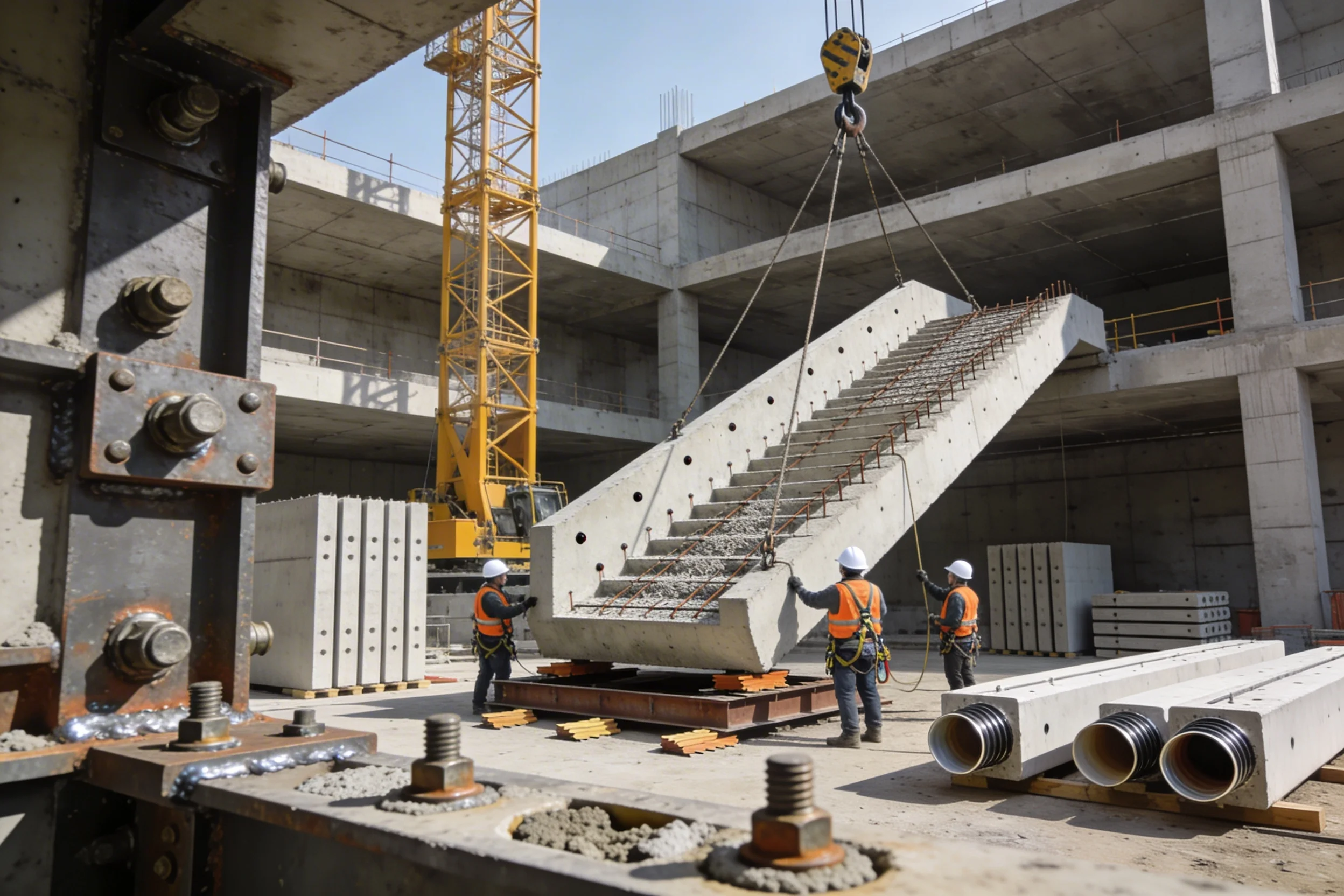
Precast Reinforced Concrete Products


Working documentation: from 14 days
Price from 50000 roubles
We design and perform calculations of reinforced concrete products, ensuring accuracy, reliability and compliance with the requirements of production, installation and operation of facilities.
We design reinforced concrete products, including flights of stairs, wall panels, columns, prestressed beams and other elements. We develop the design and calculation of reinforced concrete products, taking into account the conditions of installation, operation and architectural solutions. Properly designed reinforced concrete products ensure strength, durability and manufacturability of construction.
What's behind every precast concrete product on your site?
Precast concrete products are not just items from the precast concrete products factory catalog. Behind each flight, panel or prestressed beam there is a specific engineering task: the product must withstand design loads, survive the manufacturing process, maintain geometry during transportation and properly dock with all adjacent structures - and at the same time remain within the construction budget. AYU-Project is developing the section RC products - reinforced concrete structures. Products - consisting of design documentation and working documentation: from calculation justification to a complete set of working drawings, ready for launch into production.
Why can’t the design of precast concrete products be delegated to a specialist who works only with the monolith?
The design of reinforced concrete products is a fundamentally different engineering task than the calculation of monolithic structures. Monolithic concrete gains strength directly in the structural design of the building, where the loading conditions are initially specified. Before the prefabricated product takes its design position, it goes through several critical states: factory production with heat and humidity treatment, stripping and storage, transportation with dynamic loads, assembly slinging with concentration of forces at the gripping points. Each of these states forms a separate design combination, which may be decisive for the choice of reinforcement - and this is where the main area of errors is concentrated when working with the RC products section.
What is included in the KZhI section of the design documentation?
The KZHI section is a complete set of design and working documentation for each type of reinforced concrete product used as part of the facility. At the DD stage, the following are developed: an explanatory note describing design solutions, a list of accepted standard series and standards, and calculation justifications for each type of product. The WD for each product includes:
- Formwork drawing - geometric dimensions, location of mounting loops and sling holes, embedded parts, expansion joints, technological cutouts;
- Reinforcement drawing - layout diagrams of reinforcement cages and welded mesh, specifications of rods with steel classes, diameters and lengths;
- List of reinforcement products - summary table of frames, meshes and individual rods with the rate of steel consumption per unit of product;
- Product Specification - concrete class, volume, design and installation weight, crack resistance category;
- Joints and wiring diagrams - solutions for connecting prefabricated elements to each other and to monolithic structures.
When using standard series, reference drawings are issued indicating the grades used and the reference to a specific object. For non-standard products - a complete set of original working drawings.
What kind of reinforced concrete products do we design?
AYU-Project carries out the design of a wide range of precast concrete products - both standard and non-standard. The list of design objects includes:
- Staircases and landings - standard series LM, LMP, LMF, non-standard flights for architectural solutions; calculation of bearing capacity, reinforcement with working and structural reinforcement, taking into account loads during operation and installation;
- Wall panels - external three-layer and single-layer, internal load-bearing and non-load-bearing; taking into account wind, installation and temperature-humidity effects;
- Prestressed beams and crossbars - span structures of floors and coverings with tension of high-strength reinforcement; calculation of prestress losses and crack resistance according to SP 63.13330.2018 and SP 311.1325800.2017;
- Prefabricated Columns - rectangular, I-beam, with consoles; calculation for eccentric compression and installation loads;
- Floor slabs - multi-hollow PC and PKT series, ribbed, prestressed; selection of slab type for given loads and spans;
- Purlins, jumpers - elements of the strapping contour for supporting slabs and wall panels, calculations for bending and lateral force;
- Foundation blocks and cushions - FBS, FBP, F for strip foundations and technical subfloors;
- Individual products according to the customer’s specifications - non-standard designs outside the current standard series, with the development of technical requirements for the manufacturer.
How does designing precast concrete products for mass production differ from individual production?
These are two fundamentally different technological contexts - and AYU-Project works equally effectively with each of them. When designing for mass production, structural solutions are developed taking into account the real capabilities of the manufacturer: standard sizes of existing formwork forms, reinforcement technology on in-line stands, permissible classes of concrete, heat and moisture treatment modes. Inconsistency of documentation with the production capabilities of the enterprise is either an additional cost of non-standard equipment, or a complete impossibility of production. When designing individual products - for unique architectural or structural solutions - working drawings are developed with the issuance of specific technical requirements for concrete, reinforcement, manufacturing tolerances and acceptance conditions, adapted for production, agreed with the client.
What standards are used to design reinforced concrete products?
The regulatory framework for the design of reinforced concrete products is broader than for monolithic structures, since the work includes production and transport and installation aspects. AYU-Project carries out design in strict accordance with the current editions of the following documents:
- SP 63.13330.2018 - a basic set of rules for the calculation and design of concrete and reinforced concrete structures, including prefabricated elements;
- GOST 13015-2012 “Concrete and reinforced concrete products for construction” - general technical requirements, standardized deviations of geometric parameters, marking and acceptance rules;
- SP 311.1325800.2017 - for products made of high-strength concrete of classes B60 and higher, as well as prestressed structures;
- SNiP 3.09.01-85 - production of prefabricated reinforced concrete structures and products; technological requirements taken into account during the calculation justification;
- GOST 27751 - methodology for assessing the reliability of building structures and design combinations of loads;
- Government Decree of the Russian Federation No. 87 dated 16.02.2008 No. 87 (as amended on 21.10.2025) “On the composition of sections of design documentation and requirements for their content” - regarding the requirements for the structure and design of DD for the design section.
Updating the regulatory framework is part of the internal quality system of AYU-Project, and not a procedure performed before the delivery of a specific project.
What does the workflow for the KZhI section look like?
The development of the QLI section in AYU-Project follows a structured process: each stage undergoes internal verification before transferring the result to the client.
Stage 1 - Obtaining and analyzing initial data. We study ToR, architectural and design solutions, the range of products used, data on the conditions of production, transportation and installation.
Stage 2 - Selection of standard series. Where it is technically justified, we select products according to current standard series - this reduces the volume of WD and reduces the cost of production for the customer.
Stage 3 - Design of non-standard products. For structures that go beyond standard series, we perform a full calculation cycle: formation of geometry → determination of design loads → selection of reinforcement → verification of installation and operational load combinations → design of WD.
Stage 4 - Release design documentation and working documentation. Design documentation stage - for passing expert review; stage WD - for the production of products at the factory and their installation on site.
Stage 5 - Production and installation support. At the customer’s request, we provide designer supervision, answer technical questions from the manufacturer and promptly make clarifications to the working documentation based on the results of production tests.
Why do construction companies choose AYU-Project to develop the KZhI section?
For a construction business, the reliability of a subcontractor under section RC products is not only engineering competencies, but also the ability to fit into the production and installation construction schedule without delays.
- Calculation taking into account manufacturing technology - we take into account the real limitations of the plant, which eliminates the situation “the documentation is correct, but the product cannot be produced”;
- Optimization for serial and individual production - we use standard series as much as possible where it reduces the budget; We develop original products only where it is absolutely necessary;
- Guaranteed passing of the examination - documentation is drawn up in accordance with the requirements of Government Decree of the Russian Federation No. 87 dated 16.02.2008 No. 87 (as amended on 21.10.2025), comments are addressed free of charge within the framework of the contract;
- Cross-departmental coordination within the same team - RC products is developed in conjunction with the RC section, architectural and technological sections without time losses for external approvals;
- Subcontracting across Russia - we accept initial data in electronic form, physical presence on the site is not required;
- 8+ years of experience and proven qualifications - membership in SRO, specialists in the NOPRIZ registry, completed projects for the largest customers in the country.
How much does it cost to develop the KZhI section, and what is the schedule?
The cost of designing precast concrete products is determined by the volume of the product range, the ratio of standard and non-standard solutions, the composition of the design documentation and working documentation stages, as well as the completeness of the provided initial data. For objects of medium complexity with mixed nomenclature, the approximate development time for RC products stage DD is 2-4 weeks, stage WD - 3-7 weeks. An exact cost and time estimate is provided based on ToR or available materials. Send a request - the project manager will contact you within one business day and prepare a commercial proposal.
How work on the KZhI section is organised: project stages
-
Submit an enquiry - the initial consultation is free
Fill out the form on the website or call: +7 (383) 375-73-77 / +7 (923) 743-73-77. Indicate the type of facility, the list of reinforced concrete products (or the task for its development), and the required stages. -
Receive a Commercial Proposal Within 1 Business Day
The AYU-Project specialist will prepare CP with the price, timing and scope of work. When ordering RC products and related sections (RC, AR) at the same time, a discount is provided. -
Agree on the terms of reference and sign the contract
We clarify the composition of the documentation, product range, production requirements, file transfer format. The contract fixes the scope of work, cost and timing. -
Analysis of initial data and selection of standard series
We study ToR, design solutions, production and installation data. Where technically justified, we select products according to standard series - this reduces the volume of WD and reduces the cost for the customer. -
Calculation and design of non-standard products
For structures outside the standard series, we carry out a full calculation cycle: formation of geometry → loads during manufacturing, transportation and operation → selection of reinforcement → crack resistance testing → working drawings. -
Preparation of DD and Expert Review Support
We are releasing the QLI section of the DD stage for state or independent expert review. We accompany the examination and correct comments free of charge within the framework of the contract. -
Issue of WD and transfer of documentation
A complete set of working drawings: drawings of formwork and reinforcement, lists of reinforcement products, specifications, marking diagrams, technical requirements for manufacturing. We deliver it to the factory and for installation in PDF and DWG formats.
Our Advantages


How We Work
Frequently Asked Questions
AYU-Project work with facilities of any scale - from small industrial buildings with a limited range of precast concrete products to large industrial complexes with hundreds of standard sizes of prefabricated elements. The minimum scope of work is the development of precast concrete shop drawings for one or two types of products as part of a complex project. Specific terms of cooperation are discussed at the stage of agreeing on the technical specifications - without a threshold requirement for the scale of the facility.
If it is necessary to develop non-standard products that are not included in the current standard series, we include in the RD the technical requirements for the product - indicating the class of concrete, brand of reinforcement, manufacturing tolerances, labeling requirements and acceptance conditions. Full-format technical specifications (TU) in the form of an independent regulatory document are developed according to a separate technical specification.
Requirements for the composition of design documentation subject to examination are determined by the Russian Government Resolution No. 87 (as amended by 21.10.2025). Constructive solutions for reinforced concrete products must be reflected in the design documentation with calculation justifications. AYU-Project draws up documentation in full compliance with regulatory requirements and eliminates expert comments free of charge within the framework of the current contract.
Necessarily. For each product, we carry out a design check at the stage of transportation (support diagram in the body) and installation (lifting by hinges), since these loads often turn out to be more critical than operational loads.
Yes, this is one of the main types of our work. We design reinforced concrete products of any shape - from non-standard steps and parapet slabs to complex spatial elements - with full calculation justification and reinforcement details.
We can - and we do it regularly. If information is available on the standard sizes of forms, production capabilities and concrete used at a particular plant, design solutions are developed taking into account these limitations.
Yes. Before developing documentation, we clarify the standard dimensions of the formwork, concrete compaction technology, the presence of heat treatment and other production parameters. This eliminates the situation when a product according to the drawing cannot be manufactured using existing equipment.
Yes, prestressed structures are one of the key elements of the AYU-Project’s competence in the precast concrete shop drawings section. We carry out calculations of prestressed beams, slabs and crossbars, taking into account prestress losses, crack resistance in the first and second categories, as well as installation load combinations according to SP 63.13330.2018 and SP 311.1325800.2017.
The calculation is carried out according to SP 63.13330.2018 “Concrete and reinforced concrete structures”. For prefabricated frame buildings, SP 356.1325800.2017 is used. Manufacturing requirements for products - GOST 13015-2012, drawings - GOST 21.503-80. When designing prestressed products, we are guided by SP 311.1325800.2017 and the corresponding provisions of SP 63.
Section KZh covers monolithic and prefabricated monolithic load-bearing structures of the building as a whole - frame, floors, foundations. Section precast concrete shop drawings is devoted to specific types of prefabricated reinforced concrete products: for each, separate drawings of formwork and reinforcement are developed, the conditions of factory production, transportation and installation are taken into account. One facility often contains both sections - KZh for the monolithic frame and precast concrete shop drawings for the prefabricated elements used.
Licences and Certificates


