
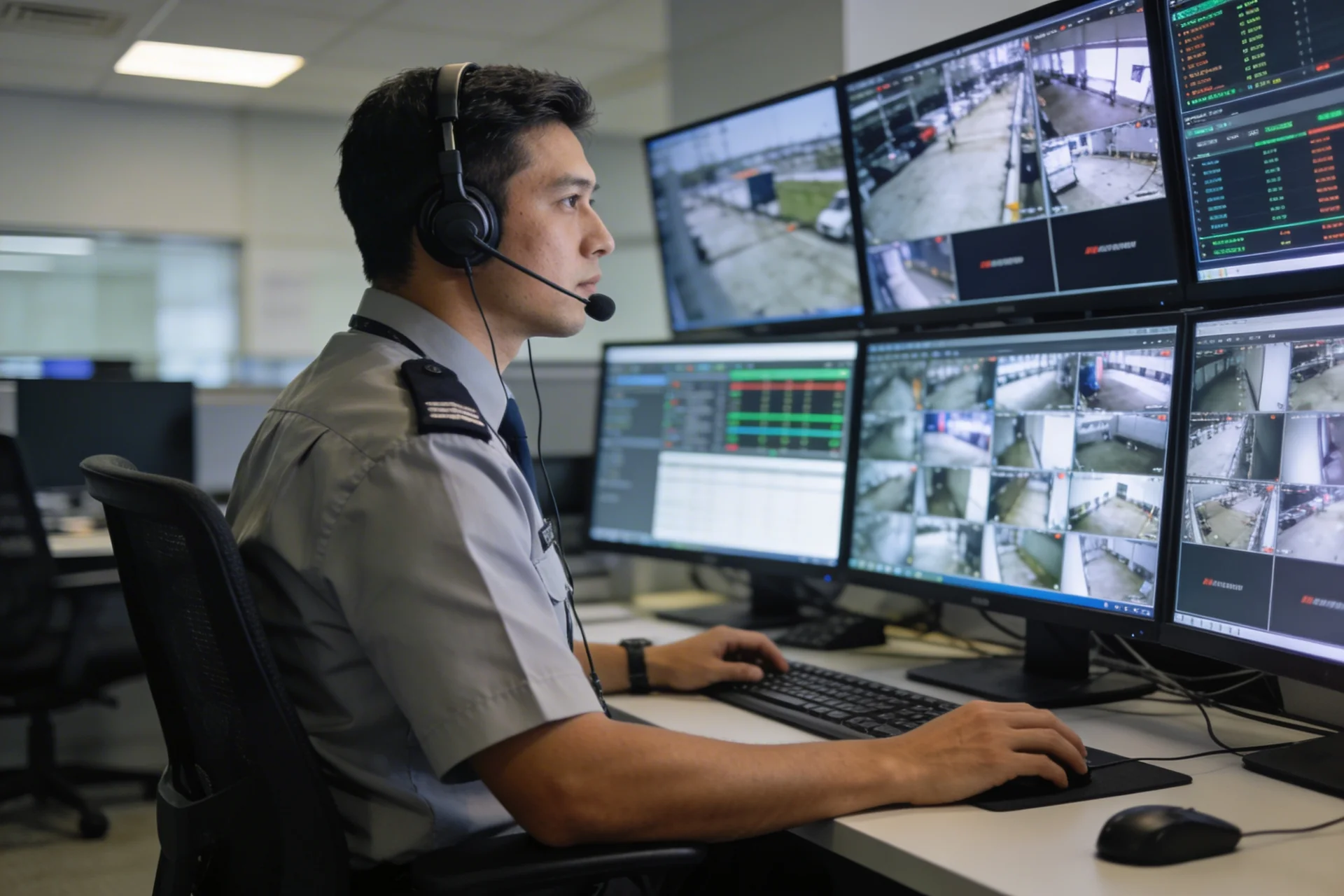
CCTV System (SOT)


Working documentation: from 7 days
Price from 50000 roubles
We design CCTV systems that provide stable visual control and recording of events, increasing the security of the facility and reducing the risks of intrusion and violations.
We develop CCTV systems for facilities of various sizes - from compact premises to distributed sites with hundreds of cameras. Design includes selecting equipment, building a video recording infrastructure, defining control zones, and integrating with other security systems. We are preparing solutions where video surveillance and CCTV technical systems operate comprehensively and reliably, providing round-the-clock monitoring, quick access to the archive and convenient management.
We design effective solutions for CCTV that allow you to be confident that every corner of the facility is under control.
CCTV systems (CCT) - design of video control with integration, analytics and round-the-clock monitoring
An intrusion sensor is triggered at the site, but the video stream is not switched to the operator’s monitors. When an attempt is made to break in, the system does not block the doors or send an alert. Or video analytics constantly generates false alarms on the shadow of a tree, distracting the operator from real events.
This occurs when a CCTV system is designed as a collection of cameras without integration into a single security system. We design CCTV so that video monitoring works in conjunction with other security systems and helps prevent incidents in real time.
What is a closed circuit television system and how does it differ from video surveillance?
A CCTV system is a complex of video cameras, archiving systems, analytics software and integration modules that provide continuous video monitoring of the facility and interaction with access, alarm and dispatch systems. CCTV differs from conventional video surveillance precisely in its integration approach - video does not work separately, but as part of a security complex, with analytical capabilities and instant response to events.
For banks, public-sector facilities, industrial facilities and high-risk facilities, CCTV is a mandatory component, often required by insurers and supervisory authorities.
What problems arise if the CCTV is not designed correctly?
When a CCTV system is designed without an integrated approach, critical shortcomings appear:
- Isolated operation without synchronization with access control system and alarm system - when an alarm is triggered, the system cannot instantly show what happened in the area of interest; The operator wastes time manually searching for the right camera
- Video analytics false alarms - analytics are not trained on real object scenarios and work on shadows, tree branches, animals; operators stop responding to alerts and miss real incidents
- Unmanaged video archive - the archive is continuously rewritten, and if you need to find an event from three days ago, it takes hours of manual search without event metadata
- Inability to scale - adding new cameras requires a complete redesign of the video recording and archiving logic; the system is not designed for object growth
All these problems are eliminated at the integrated design stage.
Our approach to designing CCTV systems
- We create CCTV systems for any surveillance scenario - we analyze the functional zones of the facility, determine critical points of video monitoring, select camera types and resolutions for each zone in accordance with usage scenarios (monitoring of entrance groups, perimeter control, supervision of storage facilities, surveillance of industrial premises)
- We integrate video control with access, security and analytics systems - in case of an event on the access control system (attempt of unauthorized entry, exceeding the input limit), the system automatically switches the video stream to the operator’s monitors and begins detailed recording; when the security alarm is triggered, the video recording switches to maximum quality mode in the area of interest
- We design taking into account the architecture of the object, lighting, flow of people and vulnerabilities - we identify blind spots and recommend optimal placement of cameras, design analytics that distinguishes normal personnel movement from potentially dangerous behavior
What is included in the design documentation for a CCTV system?
Design documentation stage - design documentation for expert review in accordance with Government Decree of the Russian Federation No. 87 dated 16.02.2008 No. 87 (as amended on 21.10.2025) “On the Composition of Design Documentation Sections and Requirements for Their Content”:
- Explanatory note describing the concept of video monitoring, integration scenarios and analytical algorithms
- Layout of video cameras indicating their types, resolution, viewing angles and coverage areas
- Schemes for integrating a video system with ACS, a burglar alarm and a fire alarm system
- Architecture of the video recording and data storage system
- Calculations of video archive, network bandwidth and uninterruptible power supply
- Equipment specification: video cameras, video recorders, software for video stream management and analytics
Working Documentation Stage (WD) - working documentation for the installation organization:
- Installation drawings linking cameras to building structures
- Cable laying diagrams and cable logs with calculation of the length of each section
- Drawings of fastening units and protection of equipment from vandalism and weather influences
- Electrical connection diagrams and power consumption calculations for calculating UPS
What standards are used to design a CCTV system?
The design of SOT is regulated by regulatory documents in the field of CCTV systems, integrated security and personal data protection. AYU-Project carries out design strictly according to the current editions of the following documents:
- GOST R 51558-2014 “Television security equipment and systems. Classification. General technical requirements. Test methods" - the main standard for CCTV, establishing the classification of CCTV systems, requirements for resolution, sensitivity, dynamic range of video cameras and conditions of their operation as part of security systems
- GOST R 53704-2009 “Security systems are comprehensive and integrated. General technical requirements" - the regulatory basis for the design of CCTV as a component of an integrated security system in conjunction with ACS, security and fire alarms
- WD 78.36.003-2002 Ministry of Internal Affairs Russia “Engineering and technical strength. Technical means of security. Requirements and design standards for protecting objects from criminal attacks" - requirements for the placement of video cameras, the organization of coverage areas and ensuring the continuity of video monitoring at facilities of various security categories
- GOST R 56602-2015 “Extra-low-voltage systems. Security systems and access control systems. Application Guide" - requirements for the design of CCTV systems, laying cable routes and selecting active equipment
- SP 484.1311500.2020 “Fire protection systems. Fire alarm systems and automation of fire protection systems. Design standards and rules" - regarding the integration of CCTV with fire alarms: automatic switching of video streams when fire sensors are triggered, video recording of the fire zone
- Federal Law No. 152-FZ “On personal data” - when designing CCTV with facial recognition functions, it determines the requirements for the processing and storage of biometric personal data, the organization of informed consent of subjects and the protection of identifier databases
- Government Decree of the Russian Federation No. 272 dated 25.03.2015 “On approval of requirements for anti-terrorism security of places where people are in large numbers” - establishes mandatory requirements for equipping objects with large numbers of people with video surveillance and closed-circuit television systems, including requirements for resolution, viewing angles and archive depth
- Government Decree of the Russian Federation No. 87 dated 16.02.2008 No. 87 (as amended on 21.10.2025) “On the composition of sections of design documentation and requirements for their content” - regarding the structure and content of the section of CCTV systems as part of the design documentation of the facility
For banking facilities and financial institutions, the design of SOT additionally takes into account the requirements of the Bank of Russia for the technical equipment of cash handling areas, vaults and operating rooms with video monitoring systems, including requirements for camera resolution and video archive storage periods.
For which facilities is a CCTV system being designed?
We develop CCTV systems for facilities of various purposes:
- banking institutions and financial organizations subject to Bank of Russia requirements
- public-sector and government facilities with increased security requirements
- industrial enterprises and production complexes
- shopping centers and chain stores with multiple observation points
- warehouse complexes and logistics centers
- cultural objects (museums, exhibitions, objects with valuables)
- residential complexes and high security facilities
- educational and medical institutions
- sports facilities and crowded places
- transport infrastructure: train stations, airports, logistics terminals
Why does the construction business trust AYU-Project to design HSE?
A CCTV system is more than just cameras and wires. Its value is determined by how accurately the project takes into account real threat scenarios, the architecture of the facility and the logic of interaction with other security systems. Errors in this matter do not appear when the object is handed over, but during the first real incident. AYU-Project excludes them already at the design stage:
- Calculation of coverage areas and illumination - for each camera, the viewing angle, clear recognition range and minimum illumination level are calculated; blind spots and areas with insufficient lighting are identified before installation, not after
- Cross-system integration - SOT is designed in a single logic with access control system, technical security systems and fire alarm system within one team; automatic response scenarios are agreed upon between systems before documentation is released
- Compliance with regulatory framework and requirements - documentation is generated according to GOST R 51558-2014, GOST R 53704-2009, Government Decree of the Russian Federation No. 272 and Government Decree of the Russian Federation No. 87; for banking facilities - taking into account the requirements of Central Bank of the Russian Federation; Expert comments are eliminated free of charge as part of the contract
- Scalable architecture - the server part and network infrastructure are designed with performance reserves; expansion of the system as the facility grows does not require reworking the existing part
- 8+ years of experience and proven qualifications - membership in SRO, specialists in the NOPRIZ registry, completed projects across Russia: from industrial enterprises and banks to shopping centers and public-sector facilities
How to order the project CCTV: stages of work
-
Submit an enquiry - the consultation is free
Form on the website or phone: +7 (383) 375-73-77 / +7 (923) 743-73-77. Specify the type of object and the objectives of the CCTV system. -
Receive a Commercial Proposal Within 1 Business Day
CP with scope of work, price and deadlines. When ordering CCTV together with other systems, there is a discount. -
Approve the ToR and sign the contract
Documentation stage, analytical functions, archive storage periods, regulatory requirements (Central Bank of the Russian Federation, EMERCOM) and security services. -
Analysis of the object and video monitoring scenarios
Functional areas, critical points, lighting conditions, people flows, vulnerabilities. If necessary, a specialist visit. -
Selection of cameras and development of integration schemes
Types and resolutions of cameras for each zone (WDR, 2K/4K, PTZ, dome). Integration schemes with ACS and alarm systems: automatic switching of the video stream to operator monitors during events. -
Designing Analytics and Storage Architecture
Analytical algorithms for real scenarios: motion detection, delay in restricted area, face recognition. Calculation of video archive, bandwidth, UPS. Redundant storage server architecture. -
Development of DD/WD and transfer to the customer
Plans with cameras and coverage sectors, integration diagrams, installation drawings with vandalism protection units, cable logs, specifications software and equipment. PDF and DWG. Expert comments are free.
Our Advantages


How We Work
Projects
Frequently Asked Questions
Basic standards: RD 78.36.002-99 (technical security equipment), GOST R 56602-2015 (low-current systems), SNiP 3.05.06-85 (electrical engineering), TsB RF requirements for banks, MChS requirements for critical infrastructure. The documentation corresponds to Russian Government Resolution No. 87 (as amended on 21.10.2025).
design documentation - documentation for examination: concept, camera plans, integration schemes, calculations. detailed design documentation - detailed installation kit: vandal-proof fastening units, cable magazines, connection diagrams. For commercial facilities, a technical working draft (design documentation+detailed design documentation) is often sufficient.
Minimum 30 days of continuous recording. For banks, storage facilities and public-sector organizations - 90 days or more. When designing, we calculate the required amount of disk space based on camera resolution, frame rate and required storage period.
Definitely. Precise time synchronization between the video system and the security alarm allows the operator to find in the archive in seconds the moment the sensor was triggered and view what happened before and after the event - critical when investigating an incident.
Video analytics is software processing of a video stream that detects events: movement in a restricted area, dismantling of a camera, delay of a person in a dangerous area, recognition of faces from a blacklist. Analytics is trained on real facility scenarios and minimizes false alarms, unlike standard motion detection.
Yes. CCTV cameras require high resolution (2K or 4K), low backlight sensitivity (WDR), support for analytical functions and operation in various lighting conditions. When designing, we select cameras for specific areas of the facility.
When the security alarm sensor is triggered, the CCTV system controller automatically switches the video stream to the operator’s monitors, starts detailed recording in the archive and sends an alarm signal with a video clip to the manager’s mobile phone. This allows you to immediately assess the situation and call a squad with complete information.
Video surveillance is simply recording video and viewing the cameras by an operator. The CCTV system is integrated with other security systems, has analytical capabilities (motion detection, face recognition, behavior analysis), has redundancy and provides instant response to events without human intervention.
Licences and Certificates


