
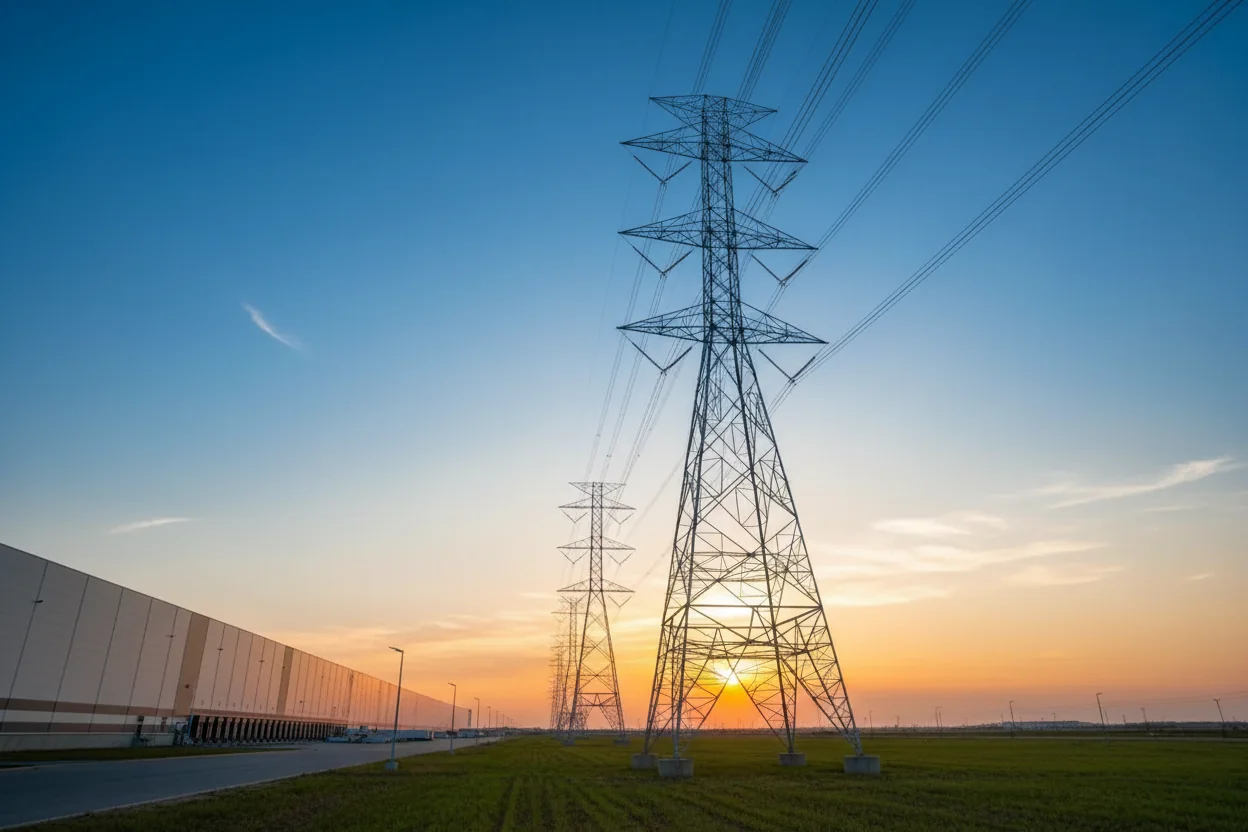
Cable and Overhead Power Lines, 0.4-10 kV


Working documentation: from 22 days
Price from 50000 roubles
We design cable-overhead power transmission and communication lines with voltage 0.4-10 kV, ensuring the reliability of the routes, optimal technical solutions and compliance with construction and operation requirements.
We carry out the design of cable power transmission and communication lines, as well as overhead and cable-overhead lines for facilities of various purposes. We develop a cable line construction project, laying diagrams, transition nodes, load calculations and technical solutions taking into account operating conditions. Proper design of cable and overhead lines ensures reliable transmission of energy and data, network security and optimal costs for project implementation.
Design of cable and overhead lines with voltage 0.4-10 kV - reliable power supply from source to consumer
Cable and overhead power lines are the arteries of power supply to any facility. The uninterrupted supply of electricity, operational safety and durability of the entire system depend on their correct design. AYU-Project develops design documentation and working documentation for cable and overhead lines with voltage of 0.4-10 kV for residential, commercial, industrial and infrastructure facilities across Russia.
What are cable and overhead lines with a voltage of 0.4-10 kV and why are they designed?
Cable and overhead lines with voltage 0.4-10 kV are electrical lines through which electricity is transmitted from the power source (substations, transformer substation, distribution point) to consumers: buildings, transformer substations, technological equipment. Voltage 0.4 kV is used to power end consumers, 6-10 kV is used to transmit electricity over long distances and power large consumers through step-down transformers.
A well-designed line ensures acceptable voltage losses, a standardized level of protection and long-term reliability of the facility’s power supply. Errors in design - incorrect choice of cable cross-section, incorrect protection circuit or unaccounted installation conditions - lead to line overheating, false shutdowns and emergency situations, which can be eliminated after installation
What types of lines do we design?
AYU-Project develops design and working documentation for the following types of lines:
- Cable lines (KL) voltage 0.4 kV- supply and distribution networks from MDB/MSB to distribution points and end consumers; installation in the ground, cable ducts, trays, pipes, overpasses
- Cable lines (KL) voltage 6-10 kV- supply lines from power centers (CP) to transformer substations of the facility; installation in the ground in compliance with standard distances to communications, in cable tunnels and galleries
- Overhead lines (OHL) with voltage 0.4 kV- on wooden, reinforced concrete or metal supports; self-supporting insulated wire (SIP) for connecting private houses, gardening communities and small objects in rural areas
- Overhead lines (OHL) with voltage 6-10 kV- for power supply to remote facilities, industrial sites and facilities in areas with sparse buildings; bare wire (AS) or coated wire (ZPA)
- Cable inserts in OHL- sections of a cable line as part of an overhead line when crossing routes with obstacles (roads, railways, reservoirs, buildings)
What is included in the design documentation for 0.4-10 kV cable and overhead lines?
Design documentation stage - design documentation for examination in accordance with Government Decree of the Russian Federation No. 87 dated 16.02.2008 (as amended on 21.10.2025):
- Explanatory note justifying the route, type of line and technical solutions for protection
- Calculation of electrical loads and selection of conductor cross-sections based on permissible heating and voltage loss
- Calculation of short circuit currents and testing of protection devices for breaking capacity
- Power supply diagram and single-line connection diagram indicating voltage levels, types of protective devices and devices
- Plan of the route of the line with drawing on a topographic basis, indicating intersections and approaches with existing communications
- Standardized distances to communications, buildings and green spaces
- Specification of equipment and materials: cables, wires, supports, fittings, protective devices
Working Documentation Stage (WD) - working documentation for the installation organization:
- Plans and profiles of a cable or overhead line route with reference to coordinates
- Installation drawings of overhead line supports with arrangement of spans and calculation of mechanical loads on wires
- Drawings of typical cable installations: in the ground, in pipes, through walls and ceilings
- List of intersections and approaches with other communications
- Cable log with calculation of lengths, types and sections of cables for each section
- Installation diagrams of end and connecting couplings
- Tasks for related organizations: for the development of PPR, for obtaining approvals from communications owners
By what standards are KL and OHL 0.4-10 kV designed?
AYU-Project carries out design strictly according to the current editions of the following regulatory documents:
- PUE (7 edition), chapters 2.3 and 2.4- “Cable lines with voltage up to 220 kV” and “Overhead power lines with voltage up to 1 kV”: requirements for the selection of conductor cross-sections, laying of cables, distances between cables and to communications, protection from mechanical damage, arrangement of connecting and end couplings
- PUE (7th edition), chapter 2.5- “Overhead power lines with voltages above 1 kV”: requirements for the selection of wires, distances between wires and from wires to the ground and buildings, support structures, lightning protection cables and insulators
- SP 76.13330.2016 “Electrical devices” (updated edition of SNiP 3.05.06-85) - requirements for the installation of cable and overhead lines: methods of laying cables, fastening wires to supports, requirements for connections, grounding and testing before commissioning
- GOST R 34.20.185-94 (IEC 60038) “Standard voltages” - sets the rated voltages of electrical networks 0.4 kV and 6-10 kV, which are used to guide the selection of equipment and insulation as part of the designed lines
- GOST R 50571- a series of standards for low voltage electrical installations: requirements for overcurrent protection, for the selection and installation of cable lines 0.4 kV, calculation of permissible current loads taking into account installation conditions
- Government Decree of the Russian Federation No. 87 dated 16.02.2008 (edited from 21.10.2025) “On the composition of sections of design documentation and requirements for their content” - regarding the structure and content of the section of external electrical networks as part of the design documentation of a capital construction project
For lines crossing federal and regional roads, railways or navigable rivers, industry standards of the relevant departments (Rosavtodor, Russian Railways, Rosmorrechflot) are additionally applied, the requirements of which are taken into account at the development stage DD when approving the route.
What does the developer risk if there are errors in cable line design?
Errors in the design of cable lines and overhead lines do not appear immediately - and that is why they are especially dangerous. An undersized cable cross-section leads to overheating of the insulation and accelerated aging - the line fails long before its standard service life. Incorrectly selected protective devices do not provide shutdown in the event of a short circuit - the accident spreads to adjacent areas. Violation of the standard distances to other communications when laying in the ground creates a risk of damage during construction work.
Coordination of the route plays a special role: uncoordinated laying of cables near other people's communications or through other people's land plots entails instructions from supervisory authorities and the need to relay an already installed line. AYU-Project processes the tracing taking into account all restrictions and prepares the necessary tasks to obtain approvals.
For what facilities are cable and overhead lines 0.4-10 kV designed?
We develop project documentation for KL and OHL for:
- residential complexes and cottage villages: external power supply from transformer substation to MDB buildings, yard distribution networks 0.4 kV
- industrial enterprises and production complexes: supply lines 6-10 kV to workshop substations, distribution networks 0.4 kV within the territory
- APK facilities and farms: overhead lines at remote sites, connection of pumping stations and granaries
- transport infrastructure facilities: power supply of stations, terminals, road lighting installations
- shopping centers and commercial real estate: backup power lines, cable inserts during reconstruction
- fuel and energy complex and industrial energy facilities: 10 kV distribution networks on the territory of enterprises
- gardening non-profit partnerships (SNT) and holiday villages: overhead lines SIP 0.4 kV
- facilities of government customers: lines for facilities Russian Railways, Rosseti, municipal power grid organizations
Why do construction companies trust AYU-Project to design 0.4-10 kV cable and overhead lines?
- Full development cycle - from analysis of the technical conditions of the network organization and route selection to the release of working documentation, ready for installation without modifications “on site”
- Coordination of the route with underground utilities- the routing of cable lines is carried out taking into account the plans of existing communications, standard distances and crossing conditions; assignments for approval are prepared as part of the project
- Calculation base, not selection from tables- cable cross-sections are determined by calculation based on permissible heating, voltage losses and currents short circuit with checking of protective devices; calculation results are included in DD
- Regulatory Compliance- documentation is generated according to the current editions of PUE, SP 76.13330.2016 and Government Decree of the Russian Federation No. 87; Expert comments are eliminated free of charge as part of the contract
- 8+ years of experience and proven qualifications- membership in SRO, specialists in the NOPRIZ registry, completed projects across Russia: from residential complexes and industrial enterprises to facilities Russian Railways and Rosseti
How to commission a 0.4-10 kV cable and overhead line project: stages of work
- Submit an enquiry - the initial consultation is free
Form on the website or phone: +7 (383) 375-73-77 / +7 (923) 743-73-77. Object, region, line type, availability of technical specifications from the network organization. - Receive a Commercial Proposal Within 1 Business Day
CP with the composition of the documentation, cost and deadlines. The price is fixed in the contract and is not revised. - Approve the ToR and sign the contract
Voltage class, line type (KL, OHL, overhead cable), stage (DD, WD or technical design), the need for coordination with the network organization. - Topobase analysis, technical specifications and routing
Topographical basis, existing communications and security zones. Comparison of route options in terms of construction and operation costs. If necessary, an engineer will visit you. - Calculation part: sections, short-circuit currents, protective devices
Selection of sections based on permissible heating and voltage loss. Calculation of currents short circuit and testing of switching devices. - Development of design documentation and working documentation: drawings, profiles, cable log
Route plans, longitudinal profiles, working drawings of structures, cable structures, junction drawings KL-OHL, cable magazine, specifications. PDF and DWG. - Grid-operator coordination and expert-review support.
We prepare the grid-connection package. The expert's comments are addressed within the agreed scope at no additional cost.
Our Advantages


How We Work
Projects
Frequently Asked Questions
To start work, a technical condition for connection is usually required, a topographic survey on the required scale with utility lines laid out, initial data on the loads of the facility and title documents for the land plot. Additionally, you may need diagrams of existing power networks, requirements of the operating organization and data on the characteristics of the territory (protection zones, security zones of power lines, roads, railway crossings).
The project complies with: Electrical Installation Code (chap. 2.3 - overhead line up to 220 kV; chapter 2.4 - overhead line up to 1 kV; chapter 2.5 - overhead line above 1 kV), SP 76.13330.2016, detailed design documentation 34.20.185-94, GOST R 50571, PP Russian Federation No. 87 (as amended by 21.10.2025). All technical solutions are checked for compliance with the requirements of the network organization.
DD stage for facilities of standard complexity - from 2 to 4 weeks; working documentation stage - from 3 to 6 weeks depending on the length of the routes and the volume of documentation. The exact terms are fixed in the contract.
CLs are laid in the ground or cable structures - they are preferable in densely built-up conditions and on industrial sites. Overhead lines on self-supporting insulated wire (SIP) are optimal for open areas and hard-to-reach areas. Cable-overhead line is a combined option for dissimilar sections of the route. The optimal choice is determined by the conditions of a particular facility.
The passage of the route through other people's land requires the registration of an easement. We prepare the technical materials necessary for contacting the relevant authorities; legal support of the transaction is provided on the client’s side.
Yes, if necessary, we participate in the coordination of technical solutions with the network organization and prepare a set of documents for going through the procedure for technological connection to electrical networks.
To develop WD for cable lines, the availability of topographical surveys and as-built documentation for existing networks significantly speeds up work and reduces the likelihood of conflicts during installation. If no research has been carried out, we can begin to develop the DD based on the available data with subsequent adjustment of the DD.
The main range is 0.4 kV (low voltage distribution lines) and 6-10 kV (medium voltage supply lines). Upon request, we consider designing lines of other voltage classes.
Yes, we work with all types of lines: cable (CL), overhead (VL) and cable-overhead, including transitions between them. For each facility, the optimal option is selected taking into account the route conditions, technical limitations and construction budget.
Licences and Certificates


