

Communication Network Design


Working documentation: from 28 days
Price from 50000 roubles
We design communication networks with predictable data transmission quality, capacity, resilience and scalability, creating infrastructure that remains fast, reliable and easy to operate.
AYU-Project designs communication networks for commercial, industrial, office and infrastructure facilities. The scope includes equipment selection, cable routing, distribution nodes, redundancy solutions and integration with related engineering systems. This approach supports stable communications, high-speed data exchange and information security.
Why should communication networks be designed as core building infrastructure?
Communication networks are sometimes coordinated too late, after major building systems have already been defined, cable shafts are occupied by power routes and the server room has been moved to an unsuitable utility area. This leads to exposed cable runs, base-station approval issues and LAN capacity that is exhausted within the first years of operation. A communication network designed in parallel with the other engineering sections is significantly more efficient than a network rebuilt after commissioning.
AYU-Project provides a full communication-network design cycle, from fibre-optic and backbone infrastructure to LAN, wireless networks, base stations and power-line carrier systems. We develop design and working documentation for all subsections of the “Communication Networks” package for residential, commercial, industrial and infrastructure facilities, including completed project experience for Russian Railways, PJSC Rosseti Siberia, FGC, NTEK and regional government bodies.
What is included in the “Communication Networks” section of the project documentation?
The “Communication Networks” subsection is part of design documentation for capital construction projects under Government Decree of the Russian Federation No. 87 dated 16.02.2008, as amended on 21.10.2025. Depending on the facility purpose and design brief, the package may include one subsystem or several dozen. The key regulatory document, SP 134.13330.2022 “Telecommunication Systems for Buildings and Structures. Basic Design Principles”, defines the composition, architecture and technical requirements for these systems.
AYU-Project designs the following communication networks and systems:
Fiber-Optic Communication Lines (FOCL)
Fibre-optic communication lines are the transport backbone of modern communication infrastructure: inter-building links, connections to telecom operators and vertical risers with capacity reserved for future growth over a 10-15 year horizon. We design fibre-optic lines of different configurations, including underground cables in HDPE ducts, aerial cables on supports or façades, building entries and optical distribution cabinet switching areas. Design and working documentation are prepared in accordance with applicable industry standards, GOST R requirements and IEC 11801 principles for optical cabling.
Structured Cabling Systems (SCS)
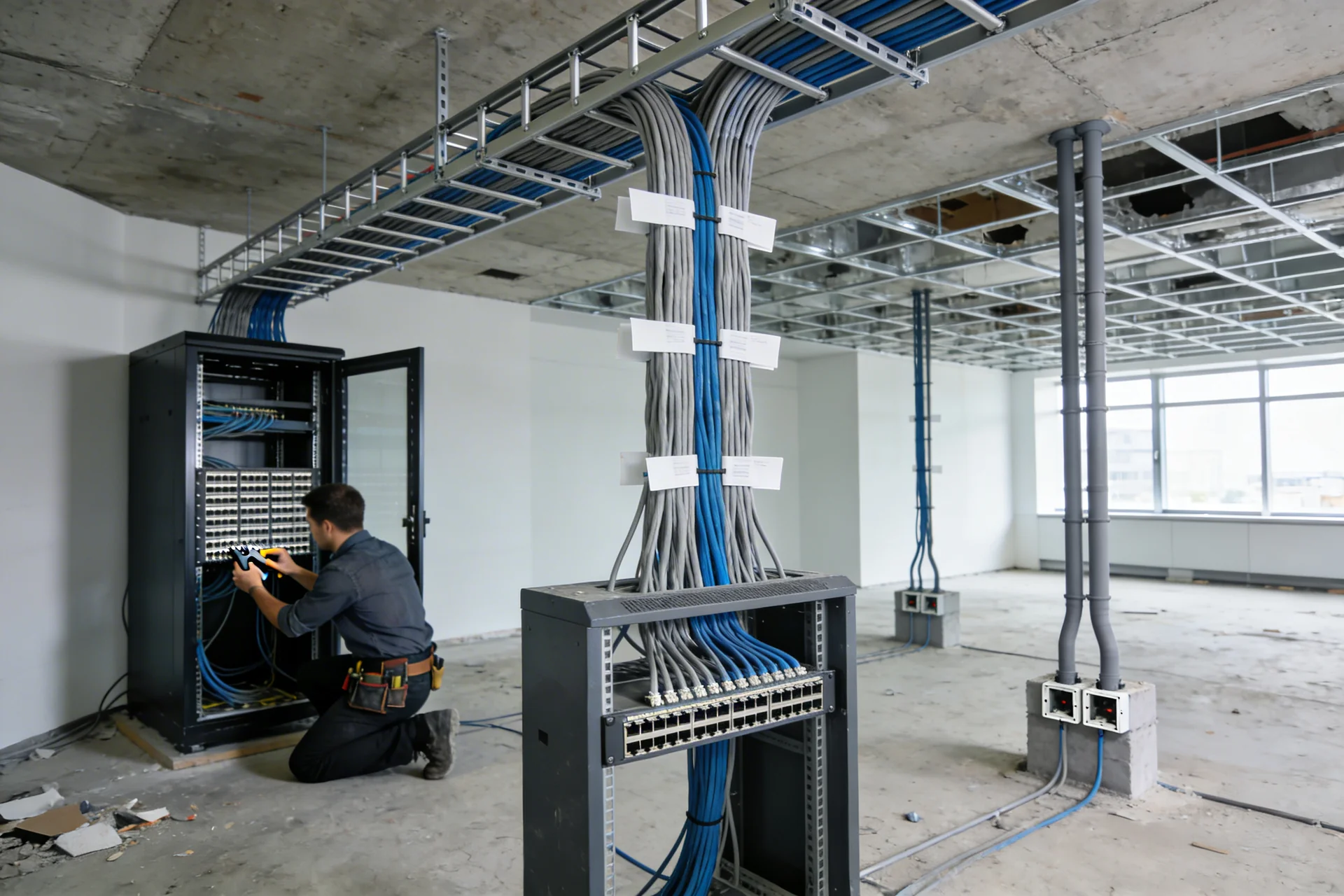
A structured cabling system is the universal physical infrastructure for data, voice and video transmission. A well-designed SCS reduces the time and cost of network reconfiguration when layouts or room functions change, which is especially important for office and retail properties. We design Category 5e, 6, 6A, 7 and 8 systems in accordance with ISO/IEC 11801, GOST R ISO/IEC 11801 and TIA-568; select active and passive equipment for current and future loads; calculate routes; and define cross-connect spaces and building entry points.
Local area networks (LAN)
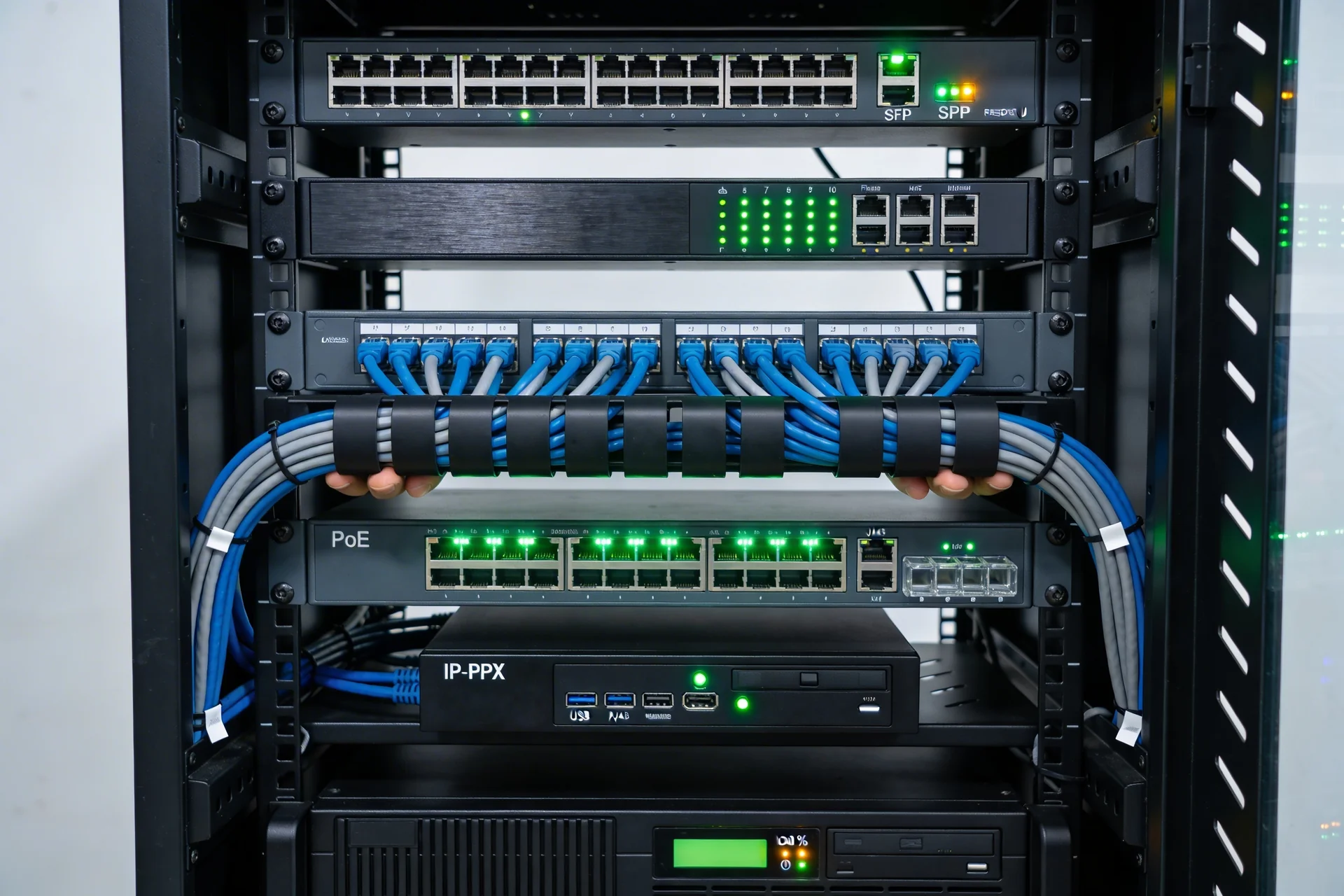
A LAN is the active data-transmission layer built on top of structured cabling or fibre-optic infrastructure: switches, routers, firewalls, server racks and network-management systems. We design LANs of different topologies and scales, from corporate office networks to distributed industrial networks with strict latency and fault-tolerance requirements. The documentation includes topology diagrams, VLAN segmentation, channel redundancy and interaction logic with other building engineering systems.
Public address and radio systems
Public address and radio systems broadcast emergency and service messages in normal and emergency operating modes. For facilities subject to fire-safety regulations, a warning and evacuation control system is mandatory. We design wired radio, voice announcement and background-audio systems, taking into account facility zoning, sound pressure levels under GOST R 53325 and integration with fire-protection automation.
Wireless communication networks
A wireless network in a commercial or industrial building is more than Wi-Fi access points in every room. It is a designed radio-frequency environment with defined coverage, calculated access-point load and controlled access policy. Facilities with metal structures, coated glazing, dense layouts or strict security requirements require RF calculations and coverage modelling; otherwise the result is unpredictable. We design Wi-Fi 6/6E infrastructure, indoor LTE and private industrial wireless networks, as well as centralised wireless network management systems.
Telephone and Internet
Connection to public communication networks and internal telephony is a required communication-network subsection for many capital construction projects. We develop technical solutions for connection to telecom operators under issued technical specifications, and design IP PBX, unified communications systems, multiservice networks and conferencing solutions. Documentation is prepared in accordance with SP 134.13330.2022 and operator requirements.
Cellular base stations
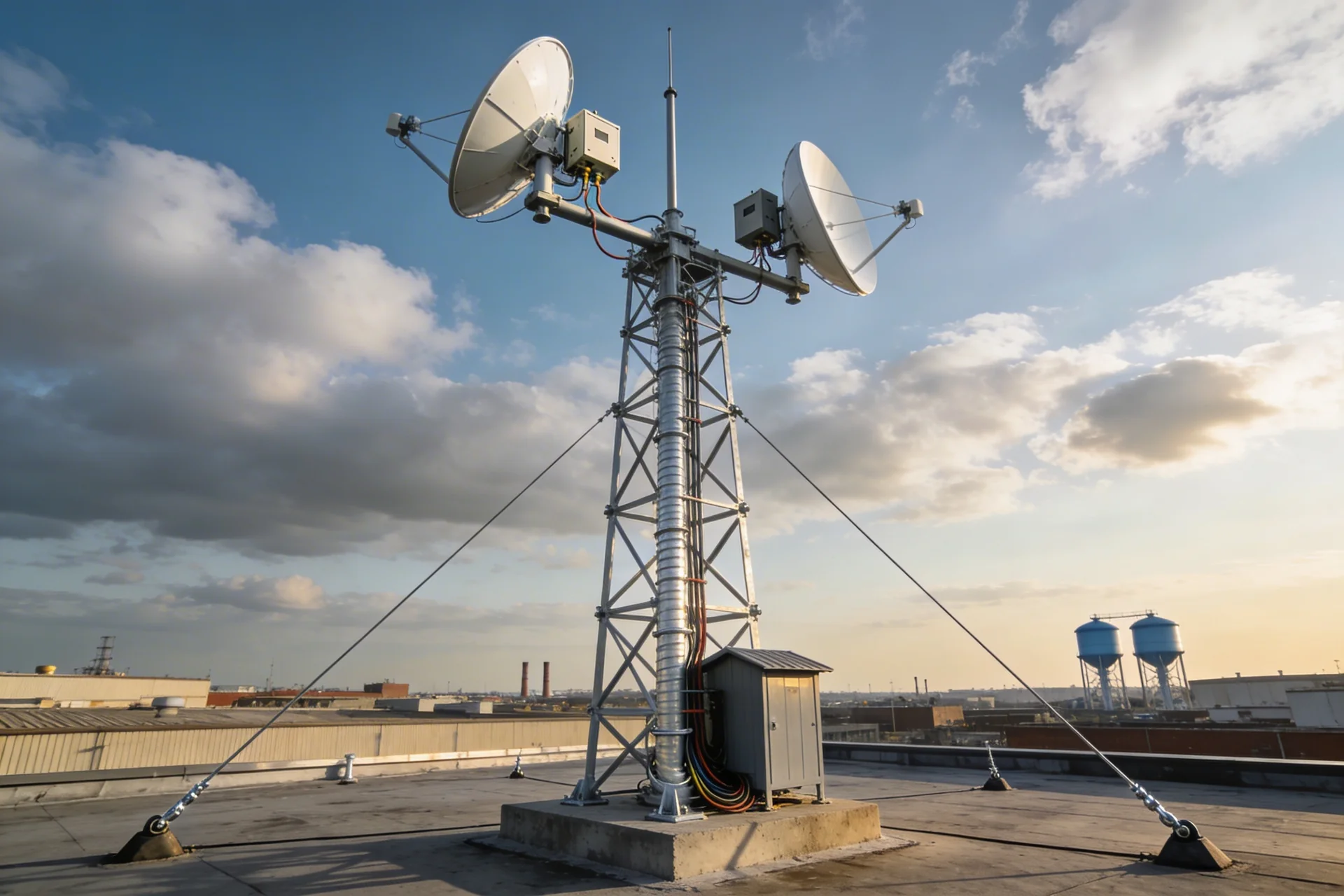
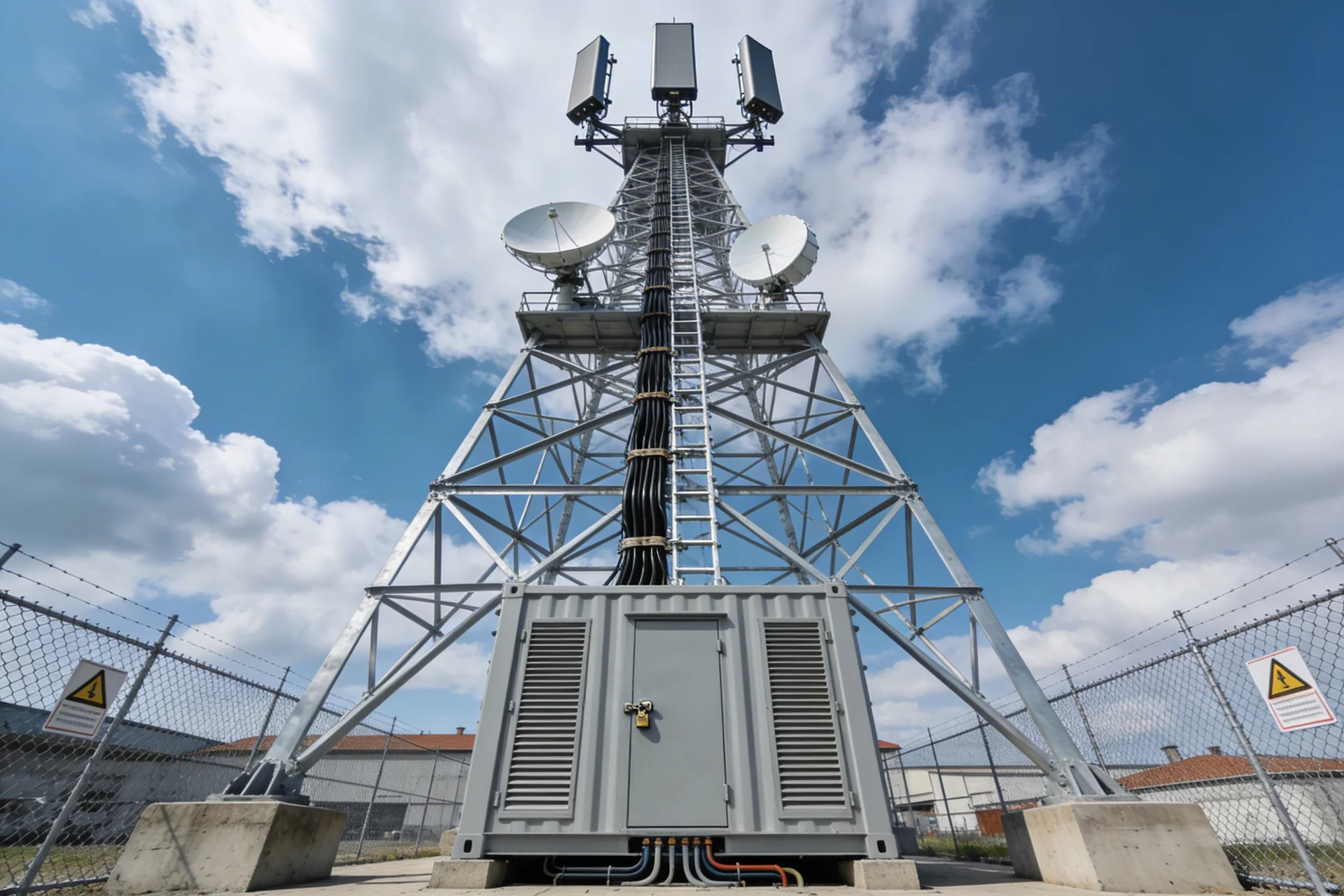
Cellular base-station design is a specialised engineering area that requires coordination with Roskomnadzor and the Federal State Unitary Enterprise “Main Radio Frequency Center”. Incomplete documentation for a base-station site is one of the common reasons for commissioning delays. We prepare full design and working documentation for construction and reconstruction of base-station facilities, including antenna-mast structures, feeder routes, power supply and air-conditioning infrastructure.
Power Line Carrier (PLC) Communications
Power-line carrier communication is a specialised engineering area used mainly in the power industry for operational communication between control centres, relay protection and telemechanics systems. PLC design is carried out under industry regulations and requires expert review in carrier-channel equipment, line traps, coupling capacitors and coupling filters. AYU-Project has practical experience designing PLC systems for power-grid facilities.
How is a communication network architecture built from scratch?
A properly designed network architecture starts with the operational task and ends with physical implementation, not the other way around. We develop it in four sequential steps.
Step 1. Requirements analysis and design brief. At this stage, the composition of communication subsystems, requirements for throughput, fault tolerance, security and scaling prospects are determined. The result is an agreed technical specification, which becomes the basis for all subsequent engineering decisions.
Step 2. Development of topology and architectural diagram. The network hierarchy (core, distribution, access), points of connection to external operators, placement of server and cross-connect rooms, backbone directions FOCL and SCS are determined. At this stage, schematic diagrams are formed that are consistent with adjacent sections of DD - especially with cable routes of power equipment.
Step 3. Detailing down to the level of equipment and cable log. Active and passive equipment is selected, cable routes are calculated, cross-connect and server spaces are arranged. This level of detail - level WD - allows the installation organization to proceed to procurement and installation without additional approvals.
Step 4. Coordination with telecom operators and regulators. If necessary, we support the receipt of technical specifications of telecom operators, as well as the approval of documentation in Roskomnadzor - for objects with BS or EVAC systems.
For which facilities do we design communication networks?
In construction B2B, a communication infrastructure is needed in one configuration or another for any object - the only question is its composition and depth.
- Residential complexes- intercom system, SOUE, fiber-optic line between sections, LAN for control and dispatch systems;
- Office and business centers- SCS, LAN, Wi-Fi, IP telephony, conference calls, connecting tenants to operators;
- Shopping and shopping and entertainment centers- data transmission networks, wired and wireless coverage, warning systems, cash register networks, video surveillance networks as part of the infrastructure SCS/LAN;
- Industrial enterprises- industrial LANs with separation of corporate and technological segments, fiber-optic lines between workshops and buildings, HF communications and dispatch systems;
- Logistics and warehouse complexes- LAN for WMS systems, wireless networks for data collection terminals, fiber optic lines;
- Electric power and transport infrastructure facilities- HF communications, technological telephony, AMC base stations and SOUE systems.
Regulatory framework for designing communication networks
Design is carried out in accordance with the following main documents:
- SP 134.13330.2022 “Telecommunication systems for buildings and structures. Design Basics" - the main set of rules that determine the composition of communication systems and requirements for DD;
- GOST R ISO/IEC 11801, ISO/IEC 11801- requirements for structured cabling systems;
- GOST R 53325- technical means of fire automatics, in terms of requirements for fire alarm system;
- GOST R 21.1101-2020- basic requirements for the design of design documentation and working documentation;
- GOST R 53111-2008- stability of the telephone network;
- Federal Law No. 126-FZ “On Communications” - regarding the requirements for joining SSOP;
- Government Decree of the Russian Federation No. 87 dated 16.02.2008 No. 87 (as amended on 21.10.2025) “On the composition of sections of project documentation and requirements for their content” - the mandatory subsection “Communication Networks” as part of DD;
- regulatory documents of the Ministry of Digital Development of Russia, Roskomnadzor and industry standards of telecom operators - regarding technical conditions for connection and requirements for accommodation facilities BS.
Cost and procedure for ordering communication network design
The cost of developing design documentation and working documentation is determined by the composition of the subsystems, the type and scale of the object, and the list of communication systems that are included in the design task. Approximate calculation - through the online calculator on the website. An accurate commercial proposal is generated free of charge after analysis of the technical specifications and initial data.
To get started, leave a request: indicate the facility type and purpose, area, region and available initial data - architectural solutions, technology brief and telecom-operator technical specifications. Our engineer will contact you within one business day. We work across Russia remotely.
How to order a communication network project: stages of work
- Submit an enquiry - the initial consultation is free
Form on the website or phone: +7 (383) 375-73-77 / +7 (923) 743-73-77. Indicate the type of object, list of subsystems and available source data. - Receive a Commercial Proposal Within 1 Business Day
CP with the composition of subsystems, cost and timing. When ordering several subsections within a single project, you will receive a discount. - Approve the ToR and sign the contract
We clarify the list of subsystems (FOCL, SCS, LAN, Wi-Fi, telephony, base stations, HF communications), the documentation stage (DD, WD or both), the requirements of telecom operators and deadlines. - Analysis of initial data and site visit (if necessary)
We study architectural solutions, specifications of telecom operators, design assignments and features of the facility. If necessary, a visit to inspect the existing infrastructure. - Development of network architecture and design solutions
Topology (core, distribution, access), tracing FOCL and SCS, placement of server and crossover spaces, selection of equipment for the budget. Linking cable routes with power networks and ventilation. - DD Stage Development and Expert Review Support
Explanatory note, schematic diagrams, equipment layout plans, technical and economic indicators according to Government Decree of the Russian Federation No. 87 (as amended on 21.10.2025). We eliminate expert review comments free of charge. - Preparation of Working Documentation (WD) and Delivery to the Client
Cable route plans, wiring diagrams, cable logs, specifications with exact articles, assignments to related sections. PDF and DWG formats.
Services




Our Advantages


How We Work
Projects
Frequently Asked Questions
The documentation complies with: SP 134.13330.2022 (building telecommunication systems), ISO/IEC 11801 and GOST R ISO/IEC 11801 (SKS), GOST R 53325 (SOUE and fire automatics), GOST R 53111-2008 (telephone networks), Federal Law No. 126-FZ “On communications”, Russian Government Resolution No. 87 (edited by 21.10.2025). Having SRO clearance and membership in NOPRIZ confirms the right to develop PD for capital construction projects.
Yes. AYU-Project designs facilities across Russia remotely - based on the provided architectural solutions, operator specifications and design assignments. If necessary, we will arrange for a specialist to visit the site for inspection and collection of initial data.
Yes, we accompany the developed documentation through state or independent expert review: we respond to experts’ comments and, if necessary, correct the documentation. This is included in the service upon conclusion of the contract - at no additional cost.
For a standard residential or office property without specialized systems - from 2 to 5 weeks for the PD stage, 4-8 weeks for the RD. For industrial facilities, facilities with VOLS highways or base stations - individually. The terms are fixed in the contract.
For subsystems that involve connection to SSOP (telephony, Internet), operator TUs are required before PD development - they determine the location and method of input, connection parameters and equipment requirements. If necessary, we help create a set of documents for the TU request.
Yes, we accept orders both for the integrated design of all communication subsystems and for individual subsections. This will require input data: architectural solutions (plans, sections), design assignment and available TUs of telecom operators.
The mandatory minimum is determined by the SP 134.13330.2022 standards and the purpose of the facility. Telephony, radio and Internet access are required for residential buildings; for buildings with permanent occupancy - fire alarm and evacuation management system (FAEMS). The remaining subsystems (LAN, SCS, Wi-Fi, HF communications, base stations) are included in the design documentation according to the design assignment based on the functional requirements of the facility.
Yes. The subsection “Communication Networks” is mandatory for capital construction projects in accordance with the Russian Federation Regulations No. 87 (as amended by 21.10.2025). Its absence is the basis for the expert’s comments and prevents obtaining permission to put the facility into operation.
Licences and Certificates


