
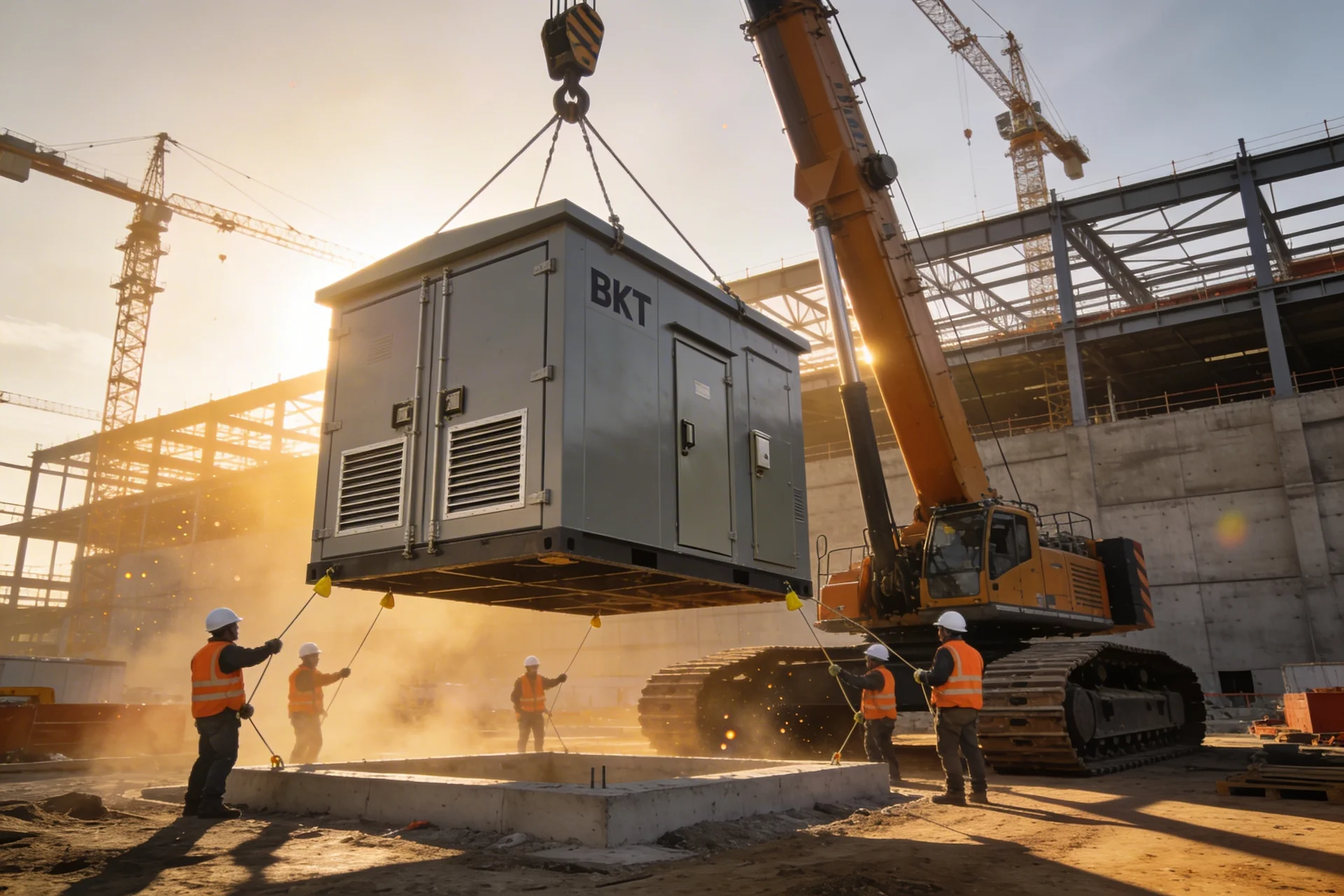
Construction and reconstruction of transformer substations 6-10 kV / 0.4 kV


Working documentation: from 22 days
Price from 50000 roubles
We carry out the construction and reconstruction of transformer substations 6-10 kV / 0.4 kV, ensuring reliable power supply, compliance with standards and uninterrupted operation of electrical networks.
We carry out the construction of transformer substations 6-10 kV / 0.4 kV for residential, commercial and industrial facilities. We carry out reconstruction of transformer substations, including replacing equipment, updating power supply circuits and increasing throughput. Proper construction and reconstruction of transformer substations ensure a stable supply of electricity and safe operation of electrical networks.
Why is a transformer substation a key power supply unit for any facility?
A 6-10 kV / 0.4 kV transformer substation is a point of transformation and distribution of electricity, the technical condition and design solutions of which determine the reliability of the power supply of the entire facility. It is here that the high voltage of the supply line is reduced to the operating level and distributed to consumers - process equipment, engineering systems, lighting. An error in the layout, incorrectly selected transformer power or missed coordination of protection at the DD stage means either chronic overload of the system or excessive capital costs for equipment with an underloaded reserve.
AYU-Project is developing design documentation and working documentation for the construction of new transformer substations and the reconstruction of existing ones - with a reasonable selection of equipment, optimal layout solutions and documentation ready for coordination with the network organization and undergoing expert review.
What types of transformer substations do we design?
We design all common types of transformer substations 6-10 kV / 0.4 kV; the choice of design solution is determined by the type of facility, available area, category of power supply reliability and technical requirements of the network organization.
- Free-standing closed transformer substation (ZTP / RTP). A permanent brick or reinforced concrete building with separate rooms for RU-10 kV, transformers and RU-0.4 kV. It is used for large residential areas, industrial enterprises and facilities with increased requirements for the reliability and durability of infrastructure.
- Built-in and attached transformer substation (VTP). Placed directly within the building or close to it. It is in demand in shopping centers, office and multifunctional complexes, where it is impractical to allocate a separate plot of land for an electrical infrastructure facility. The design of VTP is associated with a number of regulatory restrictions on placement in relation to residential and public premises - our engineers are working on these issues at an early stage.
- Complete transformer substation (package transformer substation). A factory-made product with a high degree of readiness in a metal case, mounted in open areas. Reduces construction and installation time, convenient for temporary power supply and projects with limited implementation time.
- Block-modular complete transformer substation (package transformer substation). Layout in an insulated metal or prefabricated sandwich-modular building. Optimal for harsh climatic conditions, remote sites and industrial sites. package transformer substation allows the installation of one or more transformers, built-in diesel generator and automation ATS.
What does the development of design documentation and working documentation for a transformer substation include?
The full composition of design and working documentation for a transformer substation is determined by its type, power supply circuit and reliability category of the facility. The standard kit includes the following calculations and technical solutions:
- Calculation of electrical loads and selection of the number and power of power transformers - taking into account demand factors, load schedules, permissible overload and prospects for the development of the facility;
- Selection and justification of the main electrical connection diagram - normal and post-emergency operating modes, bus partitioning schemes, normally open and normally closed devices;
- Calculation of short circuit currents (TKZ) - on the side 6-10 kV and 0.4 kV, checking switching devices for breaking capacity and dynamic resistance;
- Selection and layout of equipment RU-10 kV - cells KSO or cabinets KRU, SF6 or vacuum circuit breakers, current and voltage transformers for measurements and RPA;
- Selection and layout of RU-0.4 kV equipment - MSB, MDB, bus-section circuit breaker, ATS circuit, and reactive power compensation devices where required;
- Calculation and design of relay protection and automation (RPA) - current protection of 10 kV lines, transformer protection, automation ATS and backup power input;
- Calculation of the grounding device - checking the touch and step voltages, selection of grounding electrodes and grounding conductors in accordance with the PUE;
- Layout solutions - plan and sections of the substation, arrangement of equipment in compliance with standardized distances, cable routes and busbars;
- Specifications of equipment and materials - a complete list for procurement and delivery.
Construction of a transformer substation: when is a new facility needed?
A new transformer substation is necessary in cases where the existing network infrastructure is not capable of providing the required connection power or when the facility is being built in an undeveloped area without existing power supply centers. Typical situations that developers and technical customers come to us with:
- construction of a residential area, mixed-use complex or shopping and entertainment center with a total electrical load exceeding the capabilities of existing transformer substations;
- development of industrial sites and logistics terminals in areas without developed electrical grid infrastructure;
- creation of autonomous sites with their own power supply center - industrial complexes, data center, mining industry facilities;
- fulfillment of technical conditions for technological connection, providing for the construction of its own transformer substation on the applicant’s side.
We work out the optimal location for the substation, taking into account the power supply circuit, routes of supply cable lines and the requirements of the network organization - even before the development of DD begins, in order to avoid adjustments at later stages.
When is substation reconstruction more effective than new construction?
Reconstruction of a transformer substation is advisable when the existing facility is physically preserved, but does not meet current requirements for power, reliability or safety. Most of the transformer substations in operation today were put into operation in the 1970-1990 years - the equipment has expired, the protection is made on an outdated electromechanical base, and the capacity of the lines does not meet the increased loads.
Characteristic reasons for reconstruction:
- physical wear and tear of power transformers and distribution equipment;
- the need to increase transformer capacity when connecting new consumers or expanding production;
- replacement of outdated oil switches with modern vacuum or SF6 switches with microprocessor terminals RPA;
- non-compliance of the layout with current standards for distances and service conditions;
- implementation of telemechanics and operational dispatch control systems;
- bringing the grounding device into compliance with the requirements of PUE in terms of resistance value and touch voltage.
When reconstructing, our engineers necessarily analyze the possibility of a phased update - without completely disconnecting the facility from the power supply, which is critical for existing industries and commercial facilities.
Composition of DD for a transformer substation in accordance with regulatory requirements
Design documentation for the construction or reconstruction of a transformer substation is developed in accordance with Government Decree of the Russian Federation No. 87 dated 16.02.2008 No. 87 (as amended on 21.10.2025) “On the composition of sections of project documentation and requirements for their content.” The section “Power supply system” in the part of the transformer substation includes an explanatory note with the rationale for the technical solutions adopted, characteristics of the reliability category and redundancy schemes, a description of the main electrical connection diagram, technical characteristics of the main equipment, a description of the relay protection and automation equipment, grounding device and electrical safety measures.
Working documentation (WD) contains a complete set of installation drawings: substation plan with equipment arrangement, schematic diagrams of primary and secondary circuits, cable logs, specifications, grounding diagrams, installation diagrams of cabinets and panels RPA. The volume of WD is agreed with the customer upon conclusion of the contract.
What regulatory requirements must DD comply with for the transformer substation?
The design of 6-10 kV / 0.4 kV transformer substations is subject to an extensive regulatory framework covering technical requirements for equipment, layout solutions, protection and safety. Key documents that guide AYU-Project engineers:
- PUE (7th edition): chapters 4.2 (switchgears and substations), 3.1-3.3 (protection and automation), 1.7 (grounding and protective measures);
- GOST R 51321 - a series of standards for low-voltage complete devices;
- GOST 14209-97 - load capacity of power transformers;
- SP 76.13330.2016 "Electrical devices";
- NTP EPP-94 “Design of power supply for industrial enterprises”;
- requirements of technical conditions of the network organization and PTEEP in terms of operational requirements.
Availability of approval SRO and membership of designers in the national register of specialists NOPRIZ confirms the qualifications and right to develop DD for high-risk facilities, which include electrical installations with voltages above 1 kV.
Why do developers and contractors choose AYU-Project for transformer substation design?
AYU-Project works as a full-fledged external technical department of a construction organization: it accepts the task, develops it to the level of DD ready for examination and provides approval.
Experience at federal level facilities. Completed projects for Russian Railways, PJSC Rosseti Siberia, FGC, NTEK and Permtransgaz provide an understanding of the requirements that apply to DD at large infrastructure facilities - and this understanding is applied when working on any project.
Comprehensive study. The transformer substation is not designed in isolation from the supply cable lines, metering systems, internal power supply and RPA. We cover the entire electrical section as a single system, eliminating connection errors.
Support of approvals. The transformer substation project requires approval from the network organization, and often from Rostekhnadzor. We prepare a set of documents for these procedures and participate in responding to comments.
Fixed obligations. The development period and cost are fixed in the contract; unilateral changes are excluded.
Cost of designing transformer substations
The cost of developing design documentation and working documentation is determined individually based on the type of substation (ZTP, KTP, BKTP, built-in), the number and power of transformers, power supply circuit, the presence of relay protection and automation systems, metering systems and automatic transfer switches, as well as the design stage - DD, WD or a complete set. Reconstruction, as a rule, requires a preliminary examination of existing equipment - this stage is also included in the estimate if necessary. An approximate calculation can be obtained using the online calculator on the website. An accurate commercial proposal - after analyzing the technical conditions and initial data, free of charge.
How to order a transformer substation project: stages of work
-
Submit an enquiry - the initial consultation is free
Form on the website or phone: +7 (383) 375-73-77 / +7 (923) 743-73-77. Facility, region, required power, type of transformer substation, availability of specifications. Attach the available documents - technical specifications of the network organization, architectural solutions (AP), design assignment. -
Receive a Commercial Proposal Within 1 Business Day
CP with documentation, cost and deadlines. For reconstruction - with a preliminary examination if necessary. -
Approve the ToR and sign the contract
Type of transformer substations (ZTP, KTP, BKTP, VTP), stage (DD, WD or both), composition of sections (relay protection, automatic transfer switch, metering, grounding), requirements for coordination with the network organization and Rostechnadzor. -
Pre-design analysis: specifications, loads, location
Calculation of the number and power of transformers, location of transformer substation, routes of supply lines. For reconstruction - inspection of existing equipment. -
Calculation part: TKZ, protection, grounding
Currents short circuit on buses 10 kV and 0.4 kV, checking switching devices, protection settings, grounding device according to PUE. -
Development of design documentation and working documentation: layout, diagrams, RPA
Main diagram power supply, layout drawings, diagrams of primary and secondary circuits, installation diagrams of cabinets RPA and ATS, cable logs, specifications. PDF and DWG. -
Coordination with the network and Rostekhnadzor, expert review support
Kit for process connection. Coordination with Rostechnadzor (electrical installations above 1 kV). Expert comments - no extra charge.
Our Advantages


How We Work
Projects
Frequently Asked Questions
For a preliminary assessment, it is enough: the type and purpose of the facility, the required connection power (or available technical conditions), the proposed type of substation (ZTP, KTP, BKTP, built-in), construction region. An accurate proposal is formed after studying the technical conditions and the design assignment.
Yes, for existing production facilities and commercial facilities we are working on a phased reconstruction scheme with minimal interruptions in power supply. This issue is resolved at the stage of pre-project analysis - before the development of PD begins.
KTP is a complete prefabricated substation in a metal casing for open areas: compact, quick to install, and does not require a separate building. BKTP is a block-modular KTP in an insulated housing with the ability to integrate DGU and AVR. Optimal for harsh climates, remote sites and industrial sites with redundancy.
Yes. The composition and content of sections are formed in accordance with Russian Government Resolution No. 87 (as amended on 21.10.2025). When we receive comments from the expert, we make adjustments within the framework of contractual obligations without additional payment.
By agreement, we develop design documentation and detailed design documentation both sequentially (design documentation → examination → detailed design documentation) and in parallel. Parallel development reduces the overall period, but carries the risk of adjustments to the detailed design documentation based on the results of the design documentation examination.
Yes, relay protection and automation of the transformer substation are an integral part of the project. The design documentation and detailed design documentation include schematic diagrams of secondary circuits, protection settings, installation diagrams of relay protection and automation cabinets and secondary switching cable logs.
Yes, technical solutions for the transformer substation regarding connection to the 6-10 kV network are subject to agreement with the grid operator that issued the technical specifications. We prepare a set of materials for approval and, if necessary, participate in negotiations with the grid operator.
Yes, both areas are part of the main specialization. Reconstruction, as a rule, requires a preliminary analysis of the technical condition of existing equipment and the power supply circuit - we will organize this stage within the framework of a single contract.
Licences and Certificates


