
Public Address and Radio Broadcasting Systems (RRL)


Working documentation: from 22 days
Price from 50000 roubles
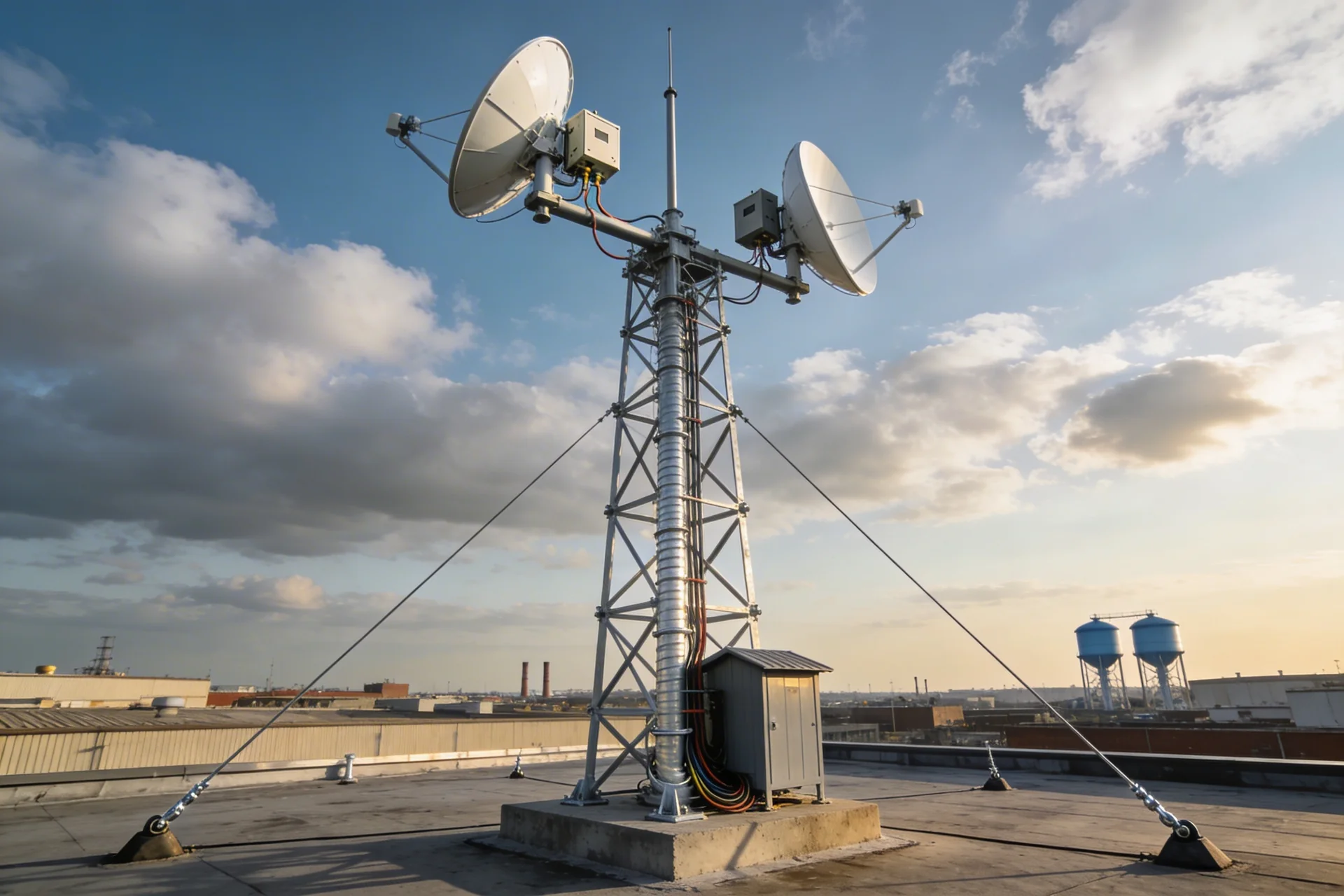
We design radio relay stations and communication lines that ensure reliable data transmission over long distances - with a guarantee of a stable signal, high throughput and minimal delays.
We design radio relay communication lines for data transfer between remote objects, industrial sites, towers and infrastructure nodes. We work out equipment placement diagrams, calculate the line of sight zone, the height of the masts and signal parameters. The professionally designed radio relay station and radio relay line provide a reliable communication channel, high speed and resistance to external influences.
Why are communications reliability and site-wide sound quality determined at the design stage?
Radio communication systems, public address systems and radio relay lines are the infrastructure on which the efficiency of facility management, personnel information and the stability of technological communications over long distances directly depend. Poorly designed acoustics results in incomprehensible announcements in a production workshop or sales area, an incorrectly designed RRL route results in an unstable channel that loses connection during precipitation. Both problems are solved by engineering calculations - electroacoustic or radio frequency - and only before installation.
AYU-Project designs warning systems, radio communications and radio relay communication lines for industrial, commercial and infrastructure facilities of any scale. We develop design documentation and working documentation on the basis of engineering calculations in accordance with current standards - the documentation is accepted by experts and regulatory authorities from the first presentation.
What warning and radio systems do we design?
AYU-Project develops design and detailed design documentation for the full range of non-fire-related warning, broadcasting and public-address systems:
Public Address System (public address communication)
Operational technological voice communication between the control center and production areas, open areas, remote posts and entry groups. Indispensable at industrial enterprises, transport facilities and energy facilities where fast voice communication without telephone padding is required. We design unidirectional and bidirectional systems that are resistant to industrial electromagnetic interference.
Radio system
Organization of broadcasting of state radio broadcasting programs and internal information messages over 30 V wired broadcast networks. For residential complexes, industrial enterprises and social infrastructure facilities, this is a regulatory requirement: it provides access to state alerts in emergency situations through a single wired network.
Local and on-site systems for alerting the population about emergencies
Information systems for facilities included in the list of potentially dangerous and critically important in accordance with Federal Law No. 68-FZ “On the protection of the population and territories from natural and man-made emergencies.” They are designed taking into account the requirements of EMERCOM Russia for the composition of signals, redundancy of power supplies and coverage of the warning zone.
Public address and music broadcast system (SORT)
Multi-zone background sound and voice information systems for shopping centers, airports, transport hubs, and sports facilities. Provides separate control of broadcast zones with the ability to prioritize voice messages over background music.
Sound information system
Voice information systems for train stations, airports, metro stations, trade and service facilities: automatic broadcast of schedules, navigation messages and commercial information.
What is electroacoustic calculation and when is it necessary?
Electroacoustic calculation is a mandatory engineering procedure when designing any public address or warning system: it proves that sirens or loudspeakers will provide the standardized sound pressure level and speech intelligibility at each point of the protected area. Without calculations, the project is incomplete and is not accepted by the expert.
Electroacoustic calculations performed by AYU-Project include:
- Determining background noise in each category of premises and areas (production workshop, sales area, open area): the signal level must exceed background noise by at least 10-15 dBA to ensure intelligibility;
- Calculation of the required sound pressure at the design point for each type of premises and its comparison with the standardized values;
- Calculation of the effective sound area one loudspeaker based on its SPL characteristics, radiation pattern and installation height;
- Determination of quantity and location loudspeakers to ensure a uniform sound field without “dead zones” and areas with unacceptable reflections;
- Calculation of the power of broadcast amplifiers and current load of lines at broadcast voltage 30 V or 120 V;
- Calculation of sound field uniformity (level spread ±3 dBA for systems SORT and public address communication).
What is RRL and when is a radio relay line used?
RRL (radio relay line) - a wireless high-speed communication channel between two fixed points, operating in line-of-sight mode in the 6-38 GHz bands. This is a technology where laying a cable is impossible, is not economically feasible or requires too long approvals from land owners and road services.
Typical scenarios for using RRL in B2B construction:
- Communication between buildings on a campus or industrial site, separated by roads, railways or water bodies: gigabit channel without excavation;
- Reserve channel for objects with the availability requirement 99,99-99,999% per year: RRL is activated automatically if the main FOCL fails;
- Connecting remote infrastructure objects - pumping stations, distribution point, transformer substations, control centers - to the corporate network in the absence of operator infrastructure in the facility area;
- Operational communication at facilities under construction - RRL is deployed without reference to the cable infrastructure.
How is the RRL route designed?
Design of RRL is a sequential engineering procedure, each step of which determines the parameters of the next.
Route profile and obstacle analysis. Based on topographic data, a longitudinal profile of the interval is constructed; the heights of obstacles (buildings, terrain, vegetation) along the route are determined.
Calculation of Fresnel zones. The radius of the first Fresnel zone at each obstacle is determined. Clearance (the distance from the line of sight to the top point of the obstacle) must be at least 0,6 the radius of the first Fresnel zone for subrefraction and at least one radius for the standard coefficient K = 4/3 - in accordance with VNTP 213-93. An obstacle entering the Fresnel zone causes diffraction losses even with a visually open line of sight.
Calculation of antenna and mast heights. Based on the condition of compliance with the standard clearance, the minimum antenna heights at each station are determined; types of mast supports are calculated and selected (mast on the roof, free-standing tower, bracket on the wall).
Energy calculation (radio budget). The signal level at the receiver input and the fade margin are calculated, taking into account the transmitter power, antenna gain, losses in feeder paths and losses in free space. Compliance with the normalized channel availability (availability) is checked, taking into account fading statistics for a given climatic region.
Selection of frequency range and equipment. It is made based on the required throughput (from 100 Mbit/s to several Gbit/s), span length and available frequency ranges according to the Roskomnadzor frequency distribution plan. Ranges 6-11 GHz - for long spans (up to 50-80 km) with moderate throughput; 18-38 GHz ranges - for short flights (1-5 km) with maximum throughput.
What is included in design documentation and working documentation?
Documentation is developed in accordance with Government Decree of the Russian Federation No. 87 dated 16.02.2008 No. 87 (as amended on 21.10.2025) “On the composition of sections of project documentation and requirements for their content”, SP 134.13330.2022 And VNTP 213-93.
Design documentation stage - warning and radio systems:
- explanatory note describing the composition and architecture of the systems;
- results of electroacoustic calculations;
- schematic diagram of the system with power supplies and redundancy;
- description of broadcast zoning.
Taxiway stage - warning and radio systems:
- plans for the placement of loudspeakers and sirens with reference to building axes;
- cable routing diagrams;
- wiring diagrams of rack equipment (amplifiers, zone controllers);
- wiring diagrams;
- specifications of equipment and materials.
Design documentation stage - RRL:
- explanatory note with analysis of the route profile, results of calculation of Fresnel zones and radio budget;
- justification for the choice of frequency range and equipment;
- communication organization diagram;
- description of the frequency matching procedure.
Working documentation stage - RRL:
- route plan with station coordinates and profile map;
- layout of equipment on masts and in equipment rooms;
- drawings of antenna supports and mounting brackets;
- power supply circuit for radio stations with redundancy;
- equipment specifications.
Regulatory framework
- Federal Law No. 68-FZ “On the protection of the population and territories from natural and man-made emergencies” - requirements for local and on-site warning systems;
- SP 134.13330.2022 “Telecommunication systems for buildings and structures” - requirements for broadcasting, radio and public address communication systems;
- GOST R 53326-2009 - equipment for warning and evacuation systems;
- VNTP 213-93 “Departmental standards for technological design. Line-of-sight radio relay transmission lines" - the main regulatory document on the design of RRL routes;
- ITU-R P.530 - methodology for calculating rain attenuation and fading on RRL routes;
- Government Decree of the Russian Federation No. 87 dated 16.02.2008 No. 87 (as amended on 21.10.2025) “On the composition of sections of project documentation and requirements for their content.”
Pricing and how to order
The cost of developing design documentation and working documentation is determined individually: for warning and radio systems - the composition of the systems, the area and number of broadcast zones, the number of sirens; for RRL - route length, required throughput, frequency range, type and height of supports. Approximate calculation - through the online calculator on the website.
To receive an accurate commercial offer, leave a request: indicate the type of object, task (public address communication, radiofication, RRL or several sections), available source data. The initial consultation is free, and we work across Russia remotely.
How to order the design of warning, radio and radio communication systems: stages of work
-
Submit an enquiry - the consultation is free
Form on the website or phone: +7 (383) 375-73-77 / +7 (923) 743-73-77. Specify the type of facility and task: GGS, radio, SORT, emergency notification, RRL or several sections. -
Receive a Commercial Proposal Within 1 Business Day
CP with scope of work, cost and timing. When ordering together with other sections of communication networks, there is a discount. -
Approve the ToR and sign the contract
We clarify the stage of documentation (DD, WD or technical working draft), the composition of systems, requirements EMERCOM for on-site warning systems, route parameters RRL and deadlines. The contract fixes the composition and cost. -
Source data analysis
For public address systems and public address communication: floor plans, room assignments, background noise by zone categories. For RRL: longitudinal route profile based on topographic data, obstacle analysis, climate zone for fading calculations. -
Performing engineering calculations
Electroacoustic calculation: sound pressure at design points, sound area, number of loudspeakers, amplifier power, field uniformity ±3 dBA. Calculation of the RRL route: Fresnel zones (clearance ≥ 0,6 R1 according to VNTP 213-93), heights of antennas and masts, radio budget according to ITU-R P.530, choice of frequency range. -
Design Documentation (DD) Development
Set DD according to Government Decree of the Russian Federation No. 87 (edited by 21.10.2025): explanatory notes with calculation results, circuit diagrams with power supplies and redundancy, communication diagrams RRL. We will eliminate the comments of the expert and EMERCOM free of charge. -
Preparation of Working Documentation (WD) and Delivery to the Client
Complete installation kit: loudspeaker placement plans, cable routing diagrams, rack equipment mounting diagrams, wiring diagrams; for RRL - route plan, drawings of antenna supports, power supply diagram with UPS, specifications with articles and materials for application to Roskomnadzor. PDF and DWG formats.
Service fees
| Scope of Work | Cost, rub. |
|---|---|
| Site inspection | Negotiable |
| Preparation of a commercial proposal (cost estimate) | Negotiable |
| Facility area, m2 | Cost, rub. |
|---|---|
| to 500 | 12 400 |
| 500 - 1000 | 32 600 |
| 1001 - 3000 | 51 500 |
| 3001 - 8000 | 82 400 |
| 8001 - 12000 | 113 200 |
| 12001 - 18000 | 144 100 |
| 18001 - 25000 | 236 800 |
| 25001 - 40000 | 298 500 |
| 40001 - ∞ | 350 000 |
Benefits of working with us
- Transparent terms of cooperation. All work is performed under a contract that establishes AYU-Project's responsibility as the contractor and reflects the client's requirements and current deadlines.
- Dedicated project manager. Every client has a designated specialist who is always available to answer project-related questions.
- Free revisions to design documentation.
- Fixed fee. Service fees are calculated according to our rates, the estimate is agreed with the client, and the final amount is fixed in the contract and cannot change before the contract is fulfilled.
Our Advantages


How We Work
Projects
Frequently Asked Questions
For radio systems and GGS of a standard facility - 2-4 weeks of design documentation and 3-5 weeks of detailed design documentation. For radio-relay link (RRL) - 3-5 weeks design documentation with route calculation; The procedure for coordinating frequencies at Roskomnadzor adds additional time according to department regulations. All terms are fixed in the contract.
The Fresnel zone is an ellipsoidal area around a straight beam between two antennas that must be free of obstacles. Even if an obstacle does not visually block the beam, its entry into the first Fresnel zone causes diffraction losses and degrades the signal quality. According to VNTP standards 213-93, the clearance must be at least 0,6 the radius of the first Fresnel zone during subrefraction - this is the basic condition for the route to work.
Yes, this is one of the most common redundancy schemes for facilities with high requirements for network availability. RRL is activated automatically when VOLS fails using fast switching protocols (RSTP, routing metric). The joint availability of two independent channels is 99,999% with correctly calculated parameters of each of them.
The 6-11 GHz range provides flights up to 50-80 km with a throughput of up to several hundred Mbit/s; ranges 18-38 GHz - spans 1-8 km with a throughput of up to 1-10 Gbit/s. Specific parameters depend on the topography of the route, the climatic zone and the characteristics of the selected equipment.
Yes. Radio relay stations operate in frequency ranges that require frequency band assignment and registration of radio electronic equipment (RES) with Roskomnadzor. Our project includes the necessary materials for filing an application for frequency assignment; If necessary, we accompany the approval procedure.
The radio system is a broadcast network for receiving state radio programs (wired radio 30 B); it is part of emergency notification, but has a broader function. Local and on-site emergency warning systems are specialized systems for potentially dangerous facilities, operating according to the requirements of the EMERCOM with standardized signals and independent power supply.
Yes. If the design documentation is approved and has passed expert review, we develop only working documentation based on it. You will need an approved DD set with the results of electroacoustic calculations (for warning systems) or with route calculations and radio budget (for RRL). Cost and terms are calculated individually.
State expert review is mandatory for publicly funded capital construction projects. For commercial facilities that do not require a building permit, a combined design and detailed-design package may be sufficient. Site-wide emergency warning systems also require approval from the relevant regional office of the Russian EMERCOM. AYU-Project supports the documentation through expert review and EMERCOM approval and resolves comments at no additional charge.
For public address and radio systems: architectural floor plans (PDF/DWG); purpose and area of premises; approximate number of broadcast zones. For RRL: cartographic data or coordinates of facilities; required channel capacity; there are restrictions on the height of antenna supports. We will clarify the missing data during a free initial consultation.
Yes. The radio system is a regulatory requirement for residential buildings: it provides access to government alerts via a wired broadcast network during emergencies. For capital construction projects, the section is included in the design documentation in accordance with Russian Government Resolution No. 87 (as amended by 21.10.2025) and SP 134.13330.2022. AYU-Project develops design documentation and detailed design documentation for radio systems for residential complexes, administrative and industrial facilities.
Licences and Certificates


