
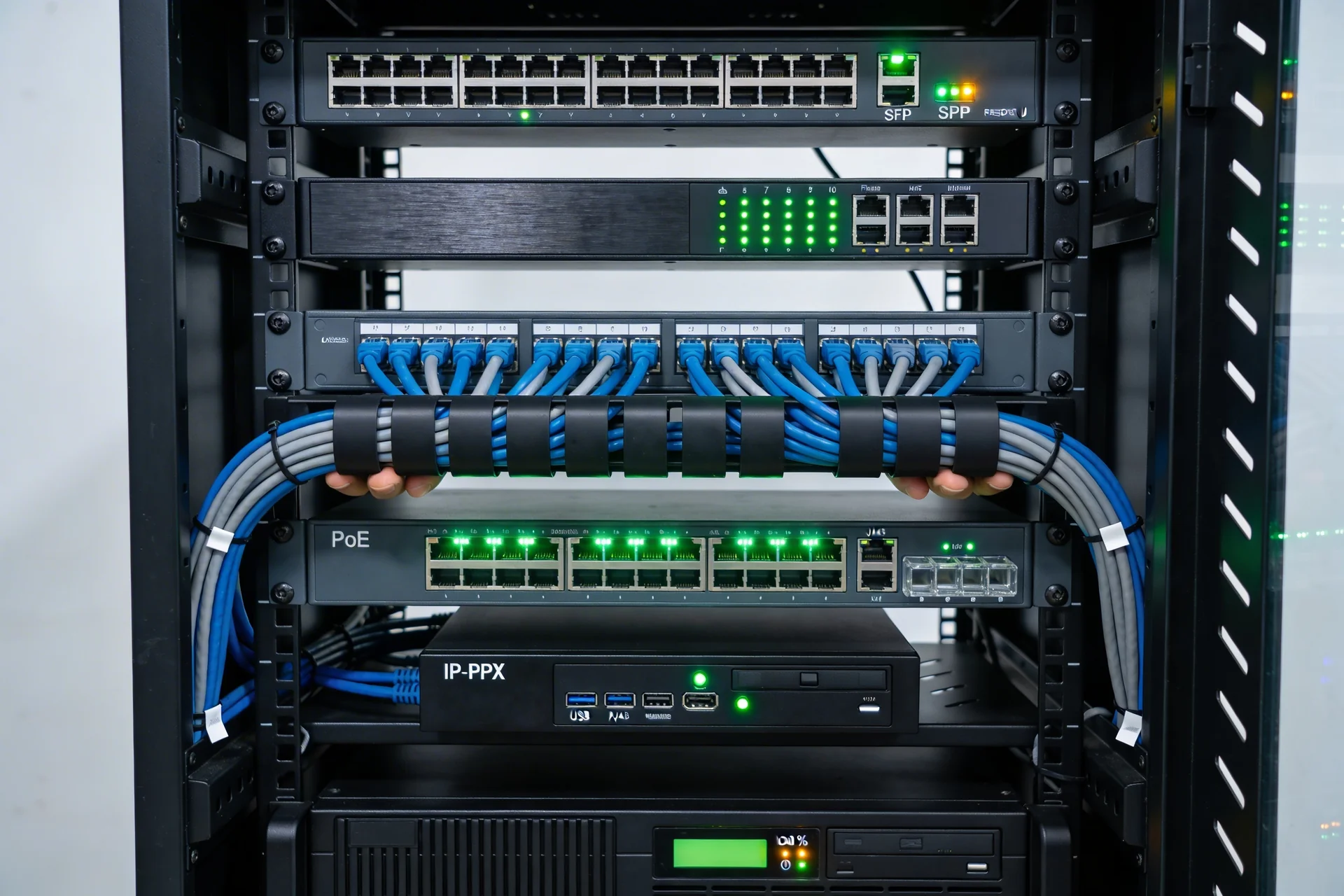
Telephone and Internet


Working documentation: from 22 days
Price from 50000 roubles
We design telephone communication systems and Internet networks, creating a reliable and scalable telecommunications infrastructure for stable communications and data transmission.
We design telephone communications and Internet networks for residential, commercial and industrial facilities. We develop a telephone communication project and Internet network design, including connection diagrams, equipment placement and communication line routing. Well-designed telephone communication systems and the Internet provide stable communication, high data transfer speeds and reliable operation.
Why should a facility’s telecommunications infrastructure be designed rather than “selected”?
Telephone communication and an Internet channel are not an option that can be configured “on the fly”: at the construction or reconstruction stage, cable routes, telecommunication cabinets, operator line entry points and the capacity of subscriber distribution devices are laid. If the bandwidth of the Internet channel is calculated without taking into account the real load (IP video surveillance, cloud services, VoIP traffic, remote workplaces), the Internet will be overloaded from the first day of operation. If the telephone circuit PABX does not provide for redundancy, one failure turns off communication at the entire facility. Both problems are resolved at the DD stage, and not after the object is handed over.
AYU-Project designs telephone communication systems and Internet networks for residential complexes, office and business centers, industrial enterprises, energy facilities, transport and social infrastructure. We develop design documentation and working documentation with full engineering work: calculation of telephone load, selection of the IP-PABX platform, channel reservation and integration of telephony with LAN, ACS and BMS of the object.
What telephone systems are used in B2B sites?
Modern corporate telephone infrastructure is built on three fundamentally different platforms - the choice between them is determined by the scale of the facility, reliability requirements, the availability of distributed sites and budget constraints.
Analogue telephone connection
Physical subscriber lines from the operator municipal telephone network or internal analog PABX (PABX). It is used on a limited basis: in areas where independence from the IP infrastructure is required (emergency telephones, security posts), or when reconstructing facilities with existing wiring. It is designed as part of a section based on the current subscriber capacities and development plans of the operator municipal telephone network.
Digital telephony (ISDN BRI/PRI, E1)
Digital subscriber and trunk lines using ISDN protocols. It is used in facilities with an existing ISDN infrastructure or when guaranteed voice quality is required without dependence on the IP packet network. In new projects it is gradually being replaced by IP telephony.
IP telephony (VoIP)
Voice transmission over an IP network using SIP, H.323 protocols. This is the dominant technology for new facilities: a unified infrastructure for voice and data, flexible numbering, integration with CRM and cloud services, significantly lower cost of intercity and international calls.
How does an IP-PBX work and what is the difference between physical and virtual?
IP-PABX (IP Private Branch Exchange) is a software and hardware complex that manages the internal telephone numbering of an object, routes calls between internal subscribers and provides access to external telephone lines through the operator’s SIP trunk or a gateway to analog/ISDN lines.
Physical IP-PABX - a hardware server (or a specialized device) with a pre-installed platform (Asterisk, FreePBX, Cisco Unified CM, 3CX, Yeastar, etc.), located in the facility’s telecommunications closet. Provides maximum independence from external services, full control over conversation data and minimal latency of internal calls. Optimal for facilities that require confidential negotiations (industrial enterprises, critical infrastructure facilities) and for sites without stable high-speed Internet access.
Virtual (cloud) IP-PABX - telecom operator service or SaaS platform, where PABX works on the provider’s side; IP phones and software clients (softphones) connect via SIP over the Internet. Advantages: no capital costs for equipment, quick deployment, single numbering for distributed offices. Disadvantages: dependence on the quality of the Internet channel and provider; requires a backup communication channel.
For facilities with several remote sites, a hybrid scheme is optimal: physical IP-PABX at the main site, remote sites are connected via a SIP trunk through a secure VPN tunnel.
Operational dispatch communication (ODS) - why is it needed?
ODS is a specialized system for immediate voice communication between the control center and dispersed subscribers (security posts, production areas, operator stations ASU transformer substation, entry groups), providing guaranteed priority communication regardless of the load on the corporate telephone network. This is not a PABX or an intercom - this is a separate engineering section with regulatory requirements for reliability, redundancy and connection establishment time.
AYU-Project designs the following operational communication systems:
- Operational dispatch communications (ODC) - a set of director telephones and specialized dispatcher consoles for large production and infrastructure facilities; call any subscriber with one button without dialing, the possibility of group conference and forced connection;
- Operational communication system - internal operational voice communication for ZhKKh facilities, electric power facilities, transport infrastructure; ensures priority of dispatcher calls over ordinary subscribers;
- Dispatcher telephone communication (DS) - integration of telephone communication with SCADA/EMS dispatch software; recording conversations, keeping an event log, synchronization with the control system.
What is a SIP trunk and how is access to the city telephone network organized?
A SIP trunk is a virtual bundle of telephone channels from a telecom operator, connected to an object’s IP-PABX via the SIP protocol via an Internet channel or a dedicated operator channel. This is a modern replacement for physical E1/ISDN lines: much cheaper, flexibly scalable (adding channels without physically relaying cables), supports direct landline numbers (DID) for each internal subscriber.
When designing a SIP trunk, the required number of simultaneous channels (lines) is calculated using the Erlang formula based on the predicted telephone load. Underestimating the number of channels leads to line occupancy during peak load; overstatement leads to unjustified expenses for subscription fees. We perform this calculation as a required part of DD.
For facilities with high requirements for telephone communication availability, redundancy is designed: a main SIP trunk from one operator and a backup one from a second independent operator. If the main IP-PBX fails, it automatically switches to the backup trunk without the participation of personnel.
How is an Internet channel for an object designed?
An Internet channel for a commercial or industrial facility is not a tariff plan for an individual: it is an engineering solution with calculation of the required bandwidth, choice of connection technology, redundancy and organization of an access network from the operator’s input point to subscriber devices.
Bandwidth calculation performed based on the number of users, type of load (office browsing, video conferencing, file transfer, cloud SaaS services, IP video surveillance with upload to the cloud, VPN tunnels to remote sites) and standardized bandwidth per user/service. Underestimating the load by 20-30% during design turns into a constantly overloaded channel throughout the entire lease term.
Connectivity technologies are selected depending on the location of the facility and the availability of operator infrastructure:
- FOCL to object - optimal option: high speed (from 100 Mbit/s to 10 Gbit/s), minimal delay, physical protection from electromagnetic interference;
- Ethernet connection over twisted pair - for facilities within 100 m from the operator’s point of presence;
- RRL (radio relay line) - for objects without the operator’s cable infrastructure within reach;
- VSAT (satellite link) - for remote objects outside the ground infrastructure zone.
Internet channel reservation - critically important for facilities where an Internet failure stops business processes (retail facilities with online POS systems, medical institutions with cloud MIS, enterprises with ERP on cloud infrastructure). A connection from two independent operators with automatic switching through a router using the BGP or PBR protocols is being designed.
What is included in design documentation and working documentation?
Documentation is developed in accordance with Government Decree of the Russian Federation No. 87 dated 16.02.2008 No. 87 (as amended on 21.10.2025) “On the composition of sections of project documentation and requirements for their content” and SP 134.13330.2022.
Design documentation stage includes:
- an explanatory note describing the adopted architecture of the telephone system, the rationale for choosing the IP-PBX platform and Internet connection technology;
- calculation of telephone load (Erlang) and the required number of SIP channels;
- calculation of Internet channel capacity;
- schematic diagram of the telephone system;
- communication diagram with designation of external and internal lines;
- description of the redundancy scheme.
Working Documentation Stage (WD) contains:
- communication organization diagram with details of all subscriber lines, trunks and operator channel entry points;
- plan for routing cable telephone lines and Internet connections with reference to construction axes;
- installation diagrams of telecommunication cabinets with placement of IP-PABX, routers, switches, UPS and patch panels;
- numbering scheme with a plan for the distribution of internal and external numbers by departments and floors;
- channel reservation and automatic switching scheme (if available);
- power supply circuit for telecommunications equipment with UPS;
- specifications of equipment and materials;
- statement of quantities.
Regulatory design basis
- SP 134.13330.2022 “Telecommunication systems for buildings and structures. Basic design provisions” - requirements for telephone communication systems, data networks and Internet connections of buildings;
- Federal Law No. 126-FZ “On Communications” - requirements for the design and operation of communication systems, organization of operator line entry points;
- GOST R 53246-2008 And GOST R 53245-2008 - in part of the cable infrastructure SCS, through which IP telephony lines pass;
- ITU-T Recommendations G.114 - requirements for delay in voice communications (no more than 150 ms one way for acceptable VoIP quality);
- RFC 3261 (SIP) - standard for the session initiation protocol underlying IP telephony;
- GOST R 21.1101-2020 - requirements for working documentation (WD) formatting;
- Government Decree of the Russian Federation No. 87 dated 16.02.2008 No. 87 (as amended on 21.10.2025) “On the composition of sections of project documentation and requirements for their content.”
Pricing and how to order
The cost of developing design documentation and working documentation is determined by the composition of the systems, the number of telephone network subscribers, the number of sites and the need for channel reservation. Approximate calculation - through the online calculator on the website.
How to order telephone and Internet network design?
-
Submit an enquiry - the consultation is free
Form on the website or phone: +7 (383) 375-73-77 / +7 (923) 743-73-77. Indicate the type of object, the approximate number of subscribers, the presence of requirements for public communication services and dispatch communications. -
Receive a Commercial Proposal Within 1 Business Day
CP with scope of work, cost and timing. When ordering together with a LAN and SCS as part of the “Communication Networks” section, you will receive a discount and a reduction in terms. -
Approve the ToR and sign the contract
We clarify the stage (DD, WD or technical working design), system composition, IP-PABX platform, requirements for ODS, channel reservation and integration with other building systems. The contract fixes the composition and cost. -
Engineering calculations
Calculation of telephone load using the Erlang formula B/C: number of SIP channels based on ChNN and permissible call loss ≤ 1-2%. Internet channel capacity calculation: VoIP (G.711/G.729), HD video conferencing, IP video surveillance, cloud SaaS/ERP, VPN tunnels. -
Design Documentation (DD) Development
Set of DD according to Government Decree of the Russian Federation No. 87 (as amended on 21.10.2025): explanatory note with calculation results, schematic diagram of the telephone system, communication organization diagram, description of redundancy. We eliminate expert review comments free of charge. -
Preparation of Working Documentation (WD) and Delivery to the Client
Communication organization diagram, floor plans for cable routing, installation diagrams of telecommunication cabinets (PABX, routers, UPS, patch panels), numbering scheme, channel reservation scheme, specifications with articles. PDF and DWG formats.
To receive an accurate commercial proposal, leave a request: indicate the type of object, the approximate number of subscribers, the presence of requirements for ODS and dispatch communications, and the available initial data. The initial consultation is free, and we work across Russia remotely.
Our Advantages


How We Work
Projects
Frequently Asked Questions
Yes. If the design documentation is approved and has passed the expert review, we develop only working documentation based on it. An approved PD kit containing a schematic diagram of the telephone system, load calculation, and redundancy description will be required. Cost and terms are calculated individually.
Yes. When a building is reconstructed or an office is changed, cable routes, the number of subscriber points and the architecture of connection to the operator change. Without an up-to-date design, installers lay cables without a numbering and routing scheme - as a result, the system works, but is not documented: in case of any malfunction or expansion, you will have to figure out the illegitimate wiring. In addition, during the reconstruction of a capital construction project, the telephony section is included in the DD according to the Government Decree of the Russian Federation No. 87.
For a facility of medium complexity (business center, industrial building) - 2-3 DD weeks and 3-4 WD weeks. With simultaneous design as part of the complex section “Communication Networks” (telephony + LAN + SCS), the time frame is reduced due to the combination of stages. The exact terms are fixed in the contract.
With a properly designed system, nothing critical. Physical IP-ATS maintains internal communication between subscribers; external communications are switched to a backup SIP trunk via a second Internet channel or to analog backup GTS lines. With a cloud ATS without a backup channel, all telephony is unavailable. That is why for facilities where telephony is critical for business processes, redundancy is designed at the PD level.
The calculation is performed using the Erlang formula B or C based on the predicted volume of calls during busy hours (ChNN) and the acceptable probability of call loss (not more than 1-2%). For an office in 100 subscribers, this is, as a rule, 10-15 simultaneous external channels - much less than is commonly believed, and it is the calculation that allows you not to overpay for extra SIP channels.
Yes - this is a standard practice when designing on the basis of SCS: a twisted pair of category 6A or 6 is routed from the telecommunications outlet to the patch panel, and the connection of a telephone or computer is determined by switching on the patch panel and VLAN settings on the switch. The IP phone connects to the switch port with PoE support and receives power via a cable without a separate power supply.
Operational dispatch communication is a mandatory section of the DD for facilities with dispatch control of technological processes: electric power facilities, pipeline transport, large production facilities. For other industrial facilities, the ODS is designed according to the client’s technical specifications; however, facilities with security, warehouses and production workshops significantly benefit from a dedicated dispatch console compared to organizing operational communications through a corporate telephone network.
For a large facility with more than 50 subscribers, requirements for confidentiality of conversations or the presence of operational dispatch communications, a physical IP-PBX is preferable: it does not depend on the Internet channel, provides internal calls when external channels fail, and stores recordings of conversations locally. For a small office or facility with several remote locations, a cloud PBX can be economically optimal, provided that the Internet channel is reserved.
Licences and Certificates


