
Design of backup, emergency and autonomous power supply systems (solar and diesel substations)


Working documentation: from 22 days
Price from 50000 roubles
We design backup, emergency and autonomous power supply systems that ensure the operation of the facility even when external networks are completely disconnected - we integrate diesel generators, solar substations, battery units and distribution boards so that energy is supplied whenever it is needed.
We carry out design of power supply of substations for industrial, transport, commercial real estate and infrastructure facilities. The substation power supply system is developed taking into account the required power reserve, switching mode, generation types and autonomy requirements. The project includes connection diagrams, calculation of cable lines, selection of equipment, as well as documentation for the power supply system of a transformer or traction substation.
The result is a highly reliable power supply that operates when the main grid is unavailable.
Why is external network failure a controlled risk and not a force majeure event?
An unexpected outage of external power supply at a facility with a continuous technological cycle, medical equipment or critical IT infrastructure is not an accident that cannot be prevented. This is an engineering problem solved at the design stage: a well-designed backup, emergency or autonomous power supply system switches the load in seconds and ensures uninterrupted operation of the facility regardless of the state of external networks.
AYU-Project develops design documentation and working documentation for backup, emergency and autonomous power supply systems: diesel power plants (DGS), solar power plants (SPP) and hybrid energy complexes DGS + SES + battery - for construction projects of any purpose, scale and degree of responsibility. We select the optimal configuration according to the requirements of the reliability category, budget and operating conditions.
How do backup, emergency and autonomous power supplies differ from each other?
These three concepts are often confused, although each describes an independent engineering concept with different equipment composition and design objectives.
Backup power supply - a system that ensures load switching to an independent backup power source in the event of a power failure in the main network. It is implemented through the ATS (automatic transfer switch) circuit with a specified normalized switching time. As a backup source, diesel generator or a second input from an independent supply line is most often used.
Emergency power supply - a reserve subset aimed at maintaining the operability of critical consumers in any case of complete blackout of the facility: lighting of evacuation routes, fire alarm and warning systems, security systems, medical life support equipment. Regulatory requirements for the composition of emergency power supply and power restoration time are determined by the purpose of the facility.
Autonomous power supply completely independent of centralized networks - the facility operates exclusively on its own generation. Relevant for remote industrial facilities, rotational camps, mining industry facilities, and also where the cost of technological connection to the network is unreasonably high.
When do regulations require a backup or emergency power source?
Mandatory backup power is determined by the category of power supply reliability, which is established at the design stage in accordance with clause 1.2.18 PUE (7th edition) based on the nature of the technological process and the consequences of a power supply interruption.
- I category and special group I category - two independent mutually redundant power supplies; for a special group - an additional third independent source (usually diesel generator). Power supply interruption is unacceptable. Such facilities include surgical departments, server rooms with high SLA, production facilities with explosive atmospheres, and traction facilities.
- II category - two independent sources; manual or automatic switching with a standardized break time is acceptable. DGS is recommended for facilities where long-term downtime entails significant economic losses.
- III category - one power source; backup source - at the request of the customer or technological specification.
Facilities for which backup power is legally required or technically necessary: medical institutions, data centers, boiler houses and pumping stations, communications and telecommunications facilities, airports and train stations, industrial enterprises with a continuous cycle.
Design of diesel power plants: a reliable reserve for objects of any category
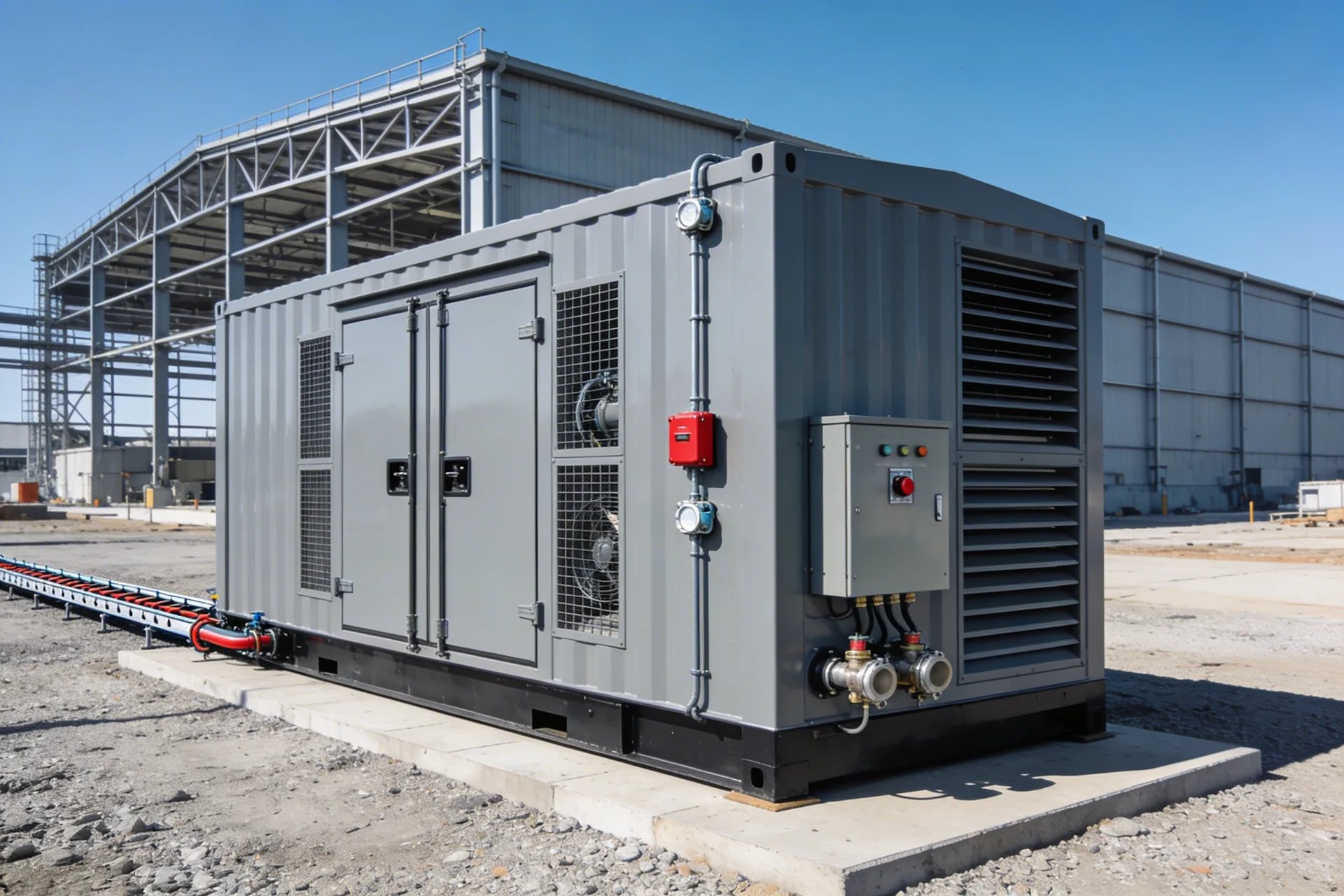
A diesel generator set is the most technically mature and widespread type of backup and autonomous power source, providing full power supply to a facility in the absence of an external network. We design diesel power plants in any design: open, in a soundproof casing, in an insulated container or a prefabricated block-modular building.
Typical areas of application in the B2B segment:
- backup power supply for objects of I and II reliability categories (hospitals, data center, shopping centers, office complexes);
- main and backup power supply to remote oil and gas industry facilities, rotational camps and production sites;
- temporary power supply to construction sites until connection to permanent networks;
- power supply of infrastructure facilities: boiler houses, pumping stations, water treatment facilities;
- emergency power supply of communication facilities, telecommunications and airfield infrastructure.
What is included in the design documentation and working documentation for a diesel power plant?
A complete set of design documentation for diesel power plant includes technical solutions necessary both for obtaining permits and passing examination, and for carrying out construction and installation work:
- situational plan and plan for linking the diesel power plant to the area: cable routes, passages for maintenance, location of the fuel tank;
- installation plan diesel generator on the base in three projections with foundation and installation dimensions;
- a plan for the location of equipment in a container or machine room in compliance with standardized distances for maintenance;
- calculation of the required power diesel generator taking into account the composition of the loads, demand factors and permissible load capacity;
- single-line power supply diagram with diesel generator, circuit diagram of the switchboard ATS with a description of the switching algorithm;
- auxiliary switchboard diagram diesel power plant;
- calculations and drawings of the grounding loop with a description of the materials used;
- calculation of the volume of the consumable fuel tank and description of the fuel supply system;
- cable magazine with cable brands, sections and lengths;
- specifications of equipment and materials.
For which facilities is a solar or hybrid power plant relevant?
A solar power plant is economically justified for facilities where several conditions coincide: a sufficient level of insolation, the presence of large roof or ground areas and a long-term planning horizon. Return on investment in the solar power plant is achieved by reducing the consumption of expensive grid electricity or eliminating the fuel and maintenance costs of the diesel generator.
The most effective areas of application in construction B2B:
- logistics and warehouse complexes with large roof areas and significant daily consumption;
- greenhouse and agro-industrial complexes with a high need for cheap electricity;
- manufacturing enterprises optimizing operating costs for electricity;
- remote objects without the ability to connect to a centralized network, where solar power plant is the main or only power source;
- facilities with environmental certification requirements or carbon footprint reduction goals.
Hybrid energy complex diesel generator + solar power plant + battery bank - the optimal solution for facilities that simultaneously need the reliability of diesel reserves and savings due to renewable generation. The solar power plant covers the daytime load and reduces the operating time of the diesel generator set; the battery pack smoothes out daily and weather fluctuations in solar generation and provides power at night. The energy flow management system automatically distributes the load between sources according to a given algorithm.
What is included in design documentation and working documentation on solar power plant and hybrid energy complex?
The solar power plant and hybrid energy complex project contains the following technical solutions and calculations:
- energy calculation of SES taking into account the geographical location of the object, orientation and angle of inclination of the panels, insolation data;
- selection of photovoltaic modules by power, KPD, temperature stability class and operating conditions;
- selection of inverter equipment - network, hybrid or off-grid inverters depending on the type solar power plant;
- calculation and design of an energy storage system: capacity, type of batteries (LiFePO4, AGM), charge and discharge control system;
- calculation and design of supporting structures - roofing (metal sheathing, ballast systems) or ground (pile and anchor foundations);
- single-line power supply diagram of a solar power plant with integration into the facility network or into the diagram of a hybrid complex of diesel generator set + solar power plant + battery;
- diagram and calculation of lightning protection and grounding of a photovoltaic system;
- system of commercial and technical electricity metering, generation monitoring;
- cable log of direct and alternating current, specifications of equipment and materials.
How to choose the type of backup power supply for a specific facility?
The choice of configuration is determined simultaneously by several parameters: category of reliability of power supply, nature of the load, availability of fuel, climatic conditions and payback horizon. Below are the key selection criteria:
| Criterion | diesel generator | solar power plant | Hybrid diesel generator+solar power plant+battery bank |
|---|---|---|---|
| Reliability when the network completely disappears | High | Depends on battery bank | High |
| Reserve commissioning time | 10-30 sec (from ATS) | Instantly (UPS/battery bank) | Instantly (battery bank) + diesel generator |
| Operating expenses | High (fuel, TO) | Low | Average |
| Relevance for remote objects | High | High | Maximum |
| Investments at the start | Average | Mid-high | High |
| Environmental friendliness | Low | High | Medium-high |
For most objects of reliability categories I and II with a connection to a centralized network, diesel generator with ATS is optimal. For remote and isolated objects - a hybrid energy complex with a focus on maximum autonomy. For facilities with large areas and high daily consumption - solar power plant with integration into the existing power supply scheme.
Regulatory framework for designing backup power supply systems
Documentation for backup, emergency and autonomous power supply systems is developed in accordance with the current regulatory and technical framework. Key documents:
- PUE (7th edition), chapters 1.2, 6.2, 6.5: requirements for reliability categories, emergency and backup power supply, ATS systems;
- GOST R 50571 - a series of standards for low voltage electrical installations;
- SP 76.13330.2016 "Electrical devices";
- GOST P IEC 62305, GOST R 58698-2019 - lightning protection and grounding;
- for solar power plant: GOST R 56980, GOST R 56980.1, technical regulations of Rostechnadzor regarding photovoltaic installations;
- Government Decree of the Russian Federation No. 87 dated 16.02.2008 No. 87 (as amended on 21.10.2025) “On the composition of sections of project documentation and requirements for their content” - regarding the composition of design documentation sections.
The equipment is selected from among those certified and approved for use in Russia, which eliminates problems when completing expert review and putting the facility into operation.
Why do developers and technical clients trust AYU-Project to design backup power?
Backup and autonomous power supply systems have been one of the key areas of work of AYU-Project since the founding of the company. Among the implemented projects are facilities for Russian Railways, PJSC Rosseti Siberia, Federal Grid Company, NTEK, Permtransgaz and a number of federal structures, where the requirements for reliability and documentation are traditionally stricter than the market average.
What do you get when collaborating with AYU-Project:
- selection of the optimal system configuration - diesel generator set, solar power plant or hybrid - with a feasibility study;
- development of design documentation and working documentation that meet the requirements of the examination from the first presentation;
- coordination of technical solutions with related sections - fire safety, low-current systems, automation;
- support of approvals with the network organization and Rostechnadzor if necessary;
- fixed terms and costs fixed in the contract.
Cost and procedure for ordering a backup power supply project
The cost of developing design documentation and working documentation is determined individually: the type and power of the reserve source, the composition of the loads, the design of the diesel power plant, the presence and complexity of the hybrid circuit, the list of documents being developed. An approximate calculation is available through the online calculator on the website. An exact proposal is formed after analyzing the technical specifications - without hidden clauses, and fixed in the contract.
To get started, leave a request: indicate the type of object, reliability category (if defined), required reserve power and region. Attach the existing technical specifications, design assignment and architectural solutions. Our engineer will contact you within one business day. We work across Russia remotely; initial consultation is free.
How to order the design of a backup, emergency or autonomous power supply system in AYU-Project: stages of work
-
Submit an enquiry - the initial consultation is free
Form on the website or phone: +7 (383) 375-73-77 / +7 (923) 743-73-77. Object, region, required power, type of transformer substation, availability of specifications. Attach the available documents - technical specifications of the network organization, architectural solutions (AP), design assignment. -
Receive a Commercial Proposal Within 1 Business Day
CP with the composition of the documentation, cost and deadlines. Engineer AYU-Project will analyze the initial data and prepare CP: optimal system configuration (diesel generator, solar power plant or hybrid) with a feasibility study, composition of design documentation and working documentation, cost and timing. -
Approve the ToR and sign the contract
We clarify the reliability category, the composition of the loads, the design of the diesel power plant, the requirements for automatic transfer switches, and the parameters of the solar power plant (if necessary). The contract fixes the scope of work, cost and terms with financial responsibility for their compliance. -
Collection and analysis of initial data
We study technical specifications, technical specifications, architectural solutions, load composition and climatic data. For SES, we perform an analysis of site insolation. We determine the estimated power of the backup source taking into account demand factors and permissible load capacity. -
Development of technical solutions and calculations
We select the type and power of diesel generator or the parameters of solar power plant/hybrid, develop the ATS circuit with a switching algorithm, design the placement of equipment, calculate grounding and lightning protection, select cables and switching equipment. -
Preparation of DD and Expert Review Support
We issue a set of DD in accordance with the Government Decree of the Russian Federation No. 87 dated 16.02.2008 No. 87 (as amended on 21.10.2025). We accompany state or independent expert reviews and correct comments free of charge within the framework of the contract. -
Issue of WD and support of construction and installation works
We produce a complete set of RDs: wiring diagrams, panel drawings, cable logs, equipment and materials specifications. We deliver in PDF and DWG formats. Upon request, we accompany construction and installation works: we respond to requests from the installation organization and issue design documentation.
Our Advantages


How We Work
Frequently Asked Questions
For typical facilities with one diesel generator set with a power of up to 500 kW - from 2 to 4 weeks for the design documentation stage, from 3 to 5 weeks for detailed design documentation. Hybrid energy complexes and facilities with multiple sources - individually. The terms are fixed in the contract.
Main documents: PUE (7 edition), chapters 1.2, 6.2, 6.5 - reliability categories, requirements for automatic transfer switches and emergency power supply; GOST R 50571 - a series of standards for low voltage electrical installations; JV 76.13330.2016 “Electrical devices”; GOST R IEC 62305, GOST R 58698-2019 - lightning protection and grounding. For SES additionally: GOST R 56980, GOST R 56980.1 and technical regulations of Rostechnadzor for photovoltaic installations. The composition of the DD is determined by the Government Decree of the Russian Federation No. 87 from 16.02.2008 N 87 (as amended on 21.10.2025).
design documentation is developed to obtain expert approval and obtain a construction permit: it contains technical solutions in a generalized form, calculation justifications and schematic diagrams. detailed design documentation is developed for construction and installation work: it includes wiring diagrams, panel drawings, cable logs and specifications with accuracy sufficient for direct execution of work. Most capital construction projects require both stages; For simple facilities, a combined stage is allowed - a technical working draft.
Yes, if the client already has a diesel generator set or a second network input, we develop only the ATS circuit and panel, including circuit diagrams, installation drawings and cable logs.
Yes. For facilities in Siberia, the Far North and the Arctic, we design diesel power plants in insulated block-modular buildings with fuel heating, autostart and battery heating systems. Climatic requirements are taken into account from the choice of design to the selection of cable brands and lubricants for diesel generator sets.
It depends on the type and category of the facility. For capital construction projects that require a construction permit, the DD regarding power supply systems (including backup sources) undergoes a mandatory examination. We prepare documentation in accordance with Government Decree of the Russian Federation No. 87 from 16.02.2008 N 87 (as amended on 21.10.2025) “On the composition of sections of project documentation and requirements for their content” and accompany the examination procedure.
Yes, both areas are part of our specialization. We also design hybrid energy complexes of diesel generator sets + solar power plants + batteries with a unified energy flow management system, which ensures maximum reliability with minimal operating costs.
These are not mutually exclusive solutions, but complementary ones. The IBP (Uninterruptible Power supply) provides instantaneous switching without interruption of power for a period of several minutes to several hours - depending on the AKB capacity. A DGU with AVR switches in 10-30 seconds, but is capable of operating indefinitely if fuel is available. For Category I Special Group facilities, both an IBP and a DGU are regulatory required.
Licences and Certificates


