
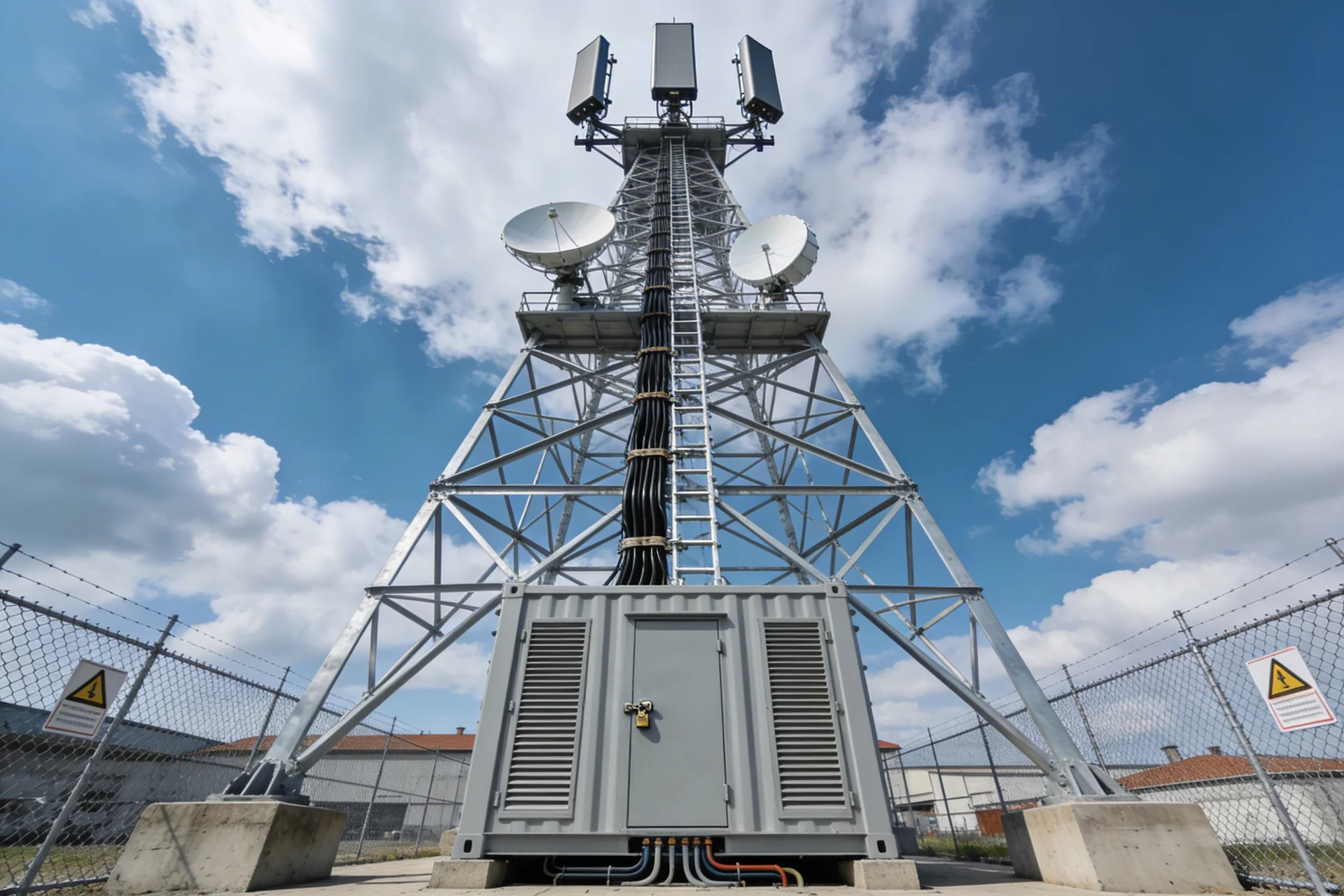
Design of cellular base stations


Working documentation: from 22 days
Price from 50000 roubles
We design cellular base stations and create a full-fledged communication infrastructure - from choosing locations and calculating coverage areas to designing highways and coordinating network nodes.
We design cellular base stations and infrastructure for telecom operators, industrial facilities, residential areas and remote areas. We develop a network of base stations with calculation of coverage areas, selection of frequencies, equipment and supporting structures. Proper design of base stations ensures high quality communications, a wide service area and stable operation even under peak loads.
Why does an incorrectly selected base station site lead to many years of coverage problems?
A base station is not just a mast with antennas: it is a precisely positioned radio node, the parameters of which are calculated in conjunction with neighboring network objects, terrain, building density and predicted traffic. An error in choosing a site and calculating the height of antennas leads to interference with neighboring sectors, “holes” in coverage in key service areas and overload of neighboring BS due to shifting subscriber load. Moving an already installed tower or redesigning the antenna mounting system is not only technically difficult, but also entails a repeated cycle of approvals.
AYU-Project designs cellular base stations for telecom operators, industrial enterprises, mining facilities and transport infrastructure. We develop design documentation and working documentation on the basis of full radio planning, engineering surveys and calculations of supporting structures - so that the station provides the design parameters of coverage and communication quality from the first day of operation.
What base stations do we design?
AYU-Project covers the full range of cellular infrastructure facilities:
Macro Cell
Base stations with antennas on high masts or towers, providing coverage of large areas: populated areas, inter-settlement highways, industrial zones, perimeters of large objects. Standards: LTE (4G), LTE-Advanced (4G+), NR (5G Sub-6 GHz). Cell radius is from 1 to 35 km depending on the range and terrain.
Microcells and small cells (Micro/Small Cell)
Network densification stations in areas with high subscriber density: business districts, shopping centers, train stations, stadiums. Installed on lighting poles, building facades, roofs. They complement the macro network without competing with it in frequency.
In-Building Solution (IBS)
Distributed Antenna System (DAS) to provide reliable coverage inside large buildings: shopping centers, airports, class A business centers, healthcare facilities. The signal is initiated from an external donor antenna, distributed throughout the building through a fiber optic or coaxial feeder and re-radiated by internal antennas.
Private corporate networks (Private LTE/5G)
Dedicated LTE or 5G NR networks for industrial enterprises, oil and gas facilities, mining enterprises and closed areas with high requirements for reliability, latency and data security. They operate in a dedicated frequency range and are isolated from public operator networks.
Radio planning - the basis of a base station project
Radio planning is the calculation of the parameters of a network of base stations, which ensures standardized indicators of coverage, signal quality and capacity throughout the entire designed area. Without it, the BS project is a set of construction drawings without a guarantee of results.
Calculation of coverage areas is performed in specialized software (Atoll, Planet, ASSET and their analogues) using a digital elevation model (DEM) and a digital building model (DEM). For each BS position, the received signal level (RSRP), the signal/noise+interference ratio (SINR) and the achievable data transfer rate at each point in the service area are calculated.
Selecting a frequency range determined by the operator’s available frequency bands and site requirements: the 700-900 MHz ranges provide the largest cell radius and good penetration into buildings; ranges 1800-2600 MHz - increased network capacity; ranges 3.4-3.8 GHz (5G) - maximum throughput over short distances.
Calculation of frequency-territorial planning (ChTP) - distribution of frequencies and codes between sectors of neighboring base stations to minimize mutual interference. This is a key parameter on which the actual data transfer speed to subscribers at the border of the service area depends.
Antenna tilt and azimuth parameters - exact values of horizontal azimuth (in degrees) and vertical tilt (mechanical tilt and electrical tilt) for each sector of each BS, ensuring specified cell boundaries and minimal radiation leakage in unwanted directions.
How is a base station site selected?
Site selection is the first and most critical stage of design: it determines the quality of the coating, the labor intensity of construction and the scope of necessary approvals. The site is assessed simultaneously according to three groups of criteria.
Radio technical criteria: compliance with the calculated position from the radio planning model; lack of screening objects in the directions of the main sectors; distance from neighboring BS within the normalized range (taking into account the distribution model).
Construction and geotechnical criteria: bearing capacity of soils for the foundation antenna-mast structure (determined based on the results of geotechnical surveys); the condition of the roof or load-bearing structures of the building when placed on the roof; windy area and icy area in accordance with maps SP 20.13330.2017 - to calculate loads on antenna-mast structure.
Legal and administrative criteria: the possibility of registering rights to the site (lease, easement); distance to residential buildings, schools, preschool institutions and medical organizations in terms of sanitary and epidemiological requirements for electromagnetic fields; the presence of restrictions on the height of structures (airfield areas, GICOD).
Antenna mast structures (antenna-mast structure): which type to choose?
antenna-mast structure is a support structure for housing antennas and, in some cases, radio equipment. The choice of type antenna-mast structure is determined by the height of the antennas, wind region, geology of the site and placement conditions.
Communication masts - lattice metal structures with braces made of steel cable; height from 30 to 120 m. Requires platforms with a sufficient radius for attaching guys (0,6-0,7 mast height). More economical than towers at the same height; At the same time, guy ropes significantly limit the possibility of developing the adjacent territory.
Communication towers - free-standing lattice or tubular metal structures without guy wires; height from 20 to 90 m. Occupy a smaller area; preferable in cramped conditions. The cost is higher than that of masts of similar height.
Roofing structures - steel frames, masts or flagpoles on the roof of buildings. They are used in urban areas where the construction of detached antenna-mast structure is impossible or impractical. An inspection of the building's load-bearing structures is required to confirm the ability to withstand additional loads.
Small-sized supports and pole structures - used for placement of small cells and microcells on existing lighting poles, contact networks, and specialized poles. The load calculation confirms the admissibility of attaching additional equipment.
The antenna-support structure design is developed as part of the design documentation in accordance with SP 20.13330.2017, SP 16.13330.2017 and GOST 24544-81. It includes a structural capacity calculation for combined wind, ice and equipment loads, together with a foundation design based on geotechnical survey data.
Communication container and base station power supply
A telecommunications container (or outdoor cabinet) is a protective unit that houses the baseband signal processing unit (or base unit), power supplies, backup batteries, and climate control system. A properly designed container is not a “booth”, but an engineered facility with standardized parameters.
Power supply The base station is designed from the nearest point of connection to the electrical networks: as a rule, from transformer substation or support OHL 0.4 kV. Power consumption of a typical macro cell is 3-8 kW; The load calculation determines the required cable cross-section and the rating of the protective automatics. A separate electricity metering point is being designed (AMR).
Backup power supply is a mandatory element for stations with a network availability requirement higher than 99,9%. Solutions:
- rechargeable batteries in a container (autonomy 4-8 hours at typical load);
- diesel generator (diesel generator) - for remote sites without stable mains power or when autonomy is required for more than 8 hours;
- combined scheme: battery bank for instant backup + diesel generator for long-term autonomy.
Climate control system provides temperature conditions in the container in the range of +5...+40°C at external temperatures from −60°C (regions of the Far North) to +45°C. Thermal calculation determines the power of air conditioning, the need for heating and the type of ventilation system.
Sanitary and epidemiological justification: why is there no permission without it?
The sanitary and epidemiological report (sanitary and epidemiological report) is a mandatory document for putting the base station into operation. It confirms that the levels of the electromagnetic field (EMP) in residential areas, in the territories of preschool and school institutions and in places where people stay do not exceed the standardized values of SanPiN 1.2.3685-21.
As part of the project, a sanitary protection zone (sanitary protection zone) is calculated for each antenna of each sector: a spatial area is determined within which the EMP level exceeds the permissible level, and it is confirmed that there are no places of permanent residence of people in this zone. The calculation is performed according to the SanPiN 1.2.3685-21 method, taking into account the total power of all transmitters and antenna patterns.
If there is a discrepancy, it is identified at the DD stage - and the parameters (suspension height, power, antenna tilt) are adjusted before the construction task is issued, and not after measurements by the supervisory authority.
What is included in the design documentation and working documentation to the base station?
Documentation is developed in accordance with Government Decree of the Russian Federation No. 87 dated 16.02.2008 No. 87 (as amended on 21.10.2025) “On the composition of sections of project documentation and requirements for their content”, SP 78.13330.2012 and industry standards of telecom operators.
Design documentation stage includes:
- an explanatory note describing the design decisions taken;
- radio planning results (coverage maps, emergency response, antenna parameters);
- power supply diagram with calculation of loads and redundancy;
- plan for placing the AWS and container on the site;
- calculation of the sanitary protection zone;
- environmental protection section.
Working Documentation Stage (WD) contains:
- drawings antenna-mast structure (general view, fastening points, attachments) with calculations of structures for standard loads;
- AMS foundation design based on geological survey data;
- site plan with reference to coordinates, fencing and landscaping;
- container installation diagrams (equipment placement, cable trays, climate control);
- power supply and power input circuit with the location of ATS and AMR;
- backup power supply circuit (battery / diesel generator set);
- grounding and lightning protection scheme according to SP 153.13130 and SO 153-34.21.122-2003;
- transport network diagram (backhole): FOCL or RRL to the nearest aggregation node;
- specifications of equipment and materials;
- statement of quantities.
Regulatory basis for the design of base stations
- SP 78.13330.2012 “Communication Facilities, Wired Broadcasting and Television” - the basic set of rules for communication facilities, including base stations;
- SP 16.13330.2017 “Steel structures” - calculation of AMS metal structures;
- SP 20.13330.2017 “Loads and impacts” - calculation of wind and ice loads;
- SP 22.13330.2016 “Foundations of buildings and structures” - design of foundations antenna-mast structure;
- SanPiN 1.2.3685-21 - permissible levels of electromagnetic fields; calculation of sanitary protection zone of base stations;
- 3GPP TS 38.104 (5G NR) / TS 36.104 (LTE) - technical parameters of base stations;
- SO 153-34.21.122-2003 - lightning protection of communication facilities;
- Government Decree of the Russian Federation No. 87 dated 16.02.2008 No. 87 (as amended on 21.10.2025) “On the composition of sections of project documentation and requirements for their content.”
Pricing and how to order
The cost of development of design documentation and working documentation depends on the type of BS (macro cell, small cell, IBS), the type and height of antenna-mast structure, the presence of geological surveys, the composition of power supply and redundancy systems, as well as the number of designed objects (cost reduction is provided for serial design for telecom operators). Approximate calculation - through the online calculator on the website.
How to order the design of a cellular base station?
-
Submit an enquiry - the consultation is free
Form on the website or phone: +7 (383) 375-73-77 / +7 (923) 743-73-77. Specify the BS type (macro cell, small cell, IBS, Private LTE/5G), standard, approximate location and available source data. -
Receive a Commercial Proposal Within 1 Business Day
CP with the scope of work, cost and deadlines. When serial designing several objects, the cost per unit is reduced. -
Pre-project analysis and approval of technical specifications
Analysis of sites according to radio engineering, construction, geotechnical and legal criteria. Clarification of the status of the object (capital / non-capital) to determine the need for state expert review. Signing the contract. -
Radio planning
Calculation of coverage areas in Atoll/Planet/ASSET using CMR/CMZ: maps of RSRP, SINR and achievable data speed. Frequency-territorial plan (ChTP). Azimuth, mechanical tilt, electrical tilt for each sector. -
Calculation of sanitary protection zone and electromagnetic field
Calculation of the sanitary protection zone according to SanPiN 1.2.3685-21. If necessary, adjust the parameters of the antennas before issuing a construction assignment. Preparation of materials for sanitary and epidemiological report. -
Design Documentation (DD) Development
Set for Government Decree of the Russian Federation No. 87 (as amended on 21.10.2025): explanatory note with the results of radio planning and calculation of sanitary protection zone, power supply diagram with redundancy, layout plan for antenna-mast structure and container. Support through the examination is free. -
Preparation of Working Documentation (WD) and Delivery to the Client
AMS drawings with structural calculations, foundation design, container installation diagrams, power supply and redundancy diagram, grounding and lightning protection diagram, backhole diagram (FOCL or RRL), specifications with articles. PDF and DWG formats.
To receive an accurate commercial proposal, leave a request: indicate the type of facility, standard (LTE/5G/Private LTE), approximate location and available initial data. The initial consultation is free, and we work remotely across Russia.
Our Advantages


How We Work
Projects
Frequently Asked Questions
Private LTE/5G is a dedicated corporate network of the LTE or 5G NR standard, operating in the enterprise’s own frequency range and completely isolated from public operator networks. It is used in oil and gas, mining, metallurgical and logistics facilities where a delay of less than 10 ms is required (for process control systems and URLLC), guaranteed network availability and confidentiality of industrial traffic. Compared to public operator coverage: full control over QoS, no dependence on an external provider and the ability to integrate with SCADA, WMS and video analytics.
Yes. To install any BS on the roof, the minimum required is: an inspection of the building’s load-bearing structures (confirmation of the admissibility of additional loads), a design of the roof structure or frame for mounting antennas, calculation of the sanitary protection zone according to SanPiN 1.2.3685-21 and coordination with Rospotrebnadzor. Without calculating the sanitary protection zone, a sanitary-epidemiological conclusion is not issued - the station cannot be put into operation. The status of the facility (capital or non-capital) is clarified at the stage of pre-project analysis.
For a typical macro cell - 3-5 DD weeks and 4-6 WD weeks. When serial designing several facilities at the same time, the time frame is reduced by one unit. Passing the state expert review (if necessary) takes additional time according to the regulations of the FAA “Glavgosexpertiza of Russia” or regional expert organizations. All terms are fixed in the contract.
Registration of rights to the site (lease agreement with the owner of the roof, land lease agreement or easement) is the responsibility of the telecom operator or the project client. We carry out preliminary radio planning and help formulate technical requirements for the site, which simplifies negotiations with potential lessors.
Yes - this is called colocation. AMS is designed taking into account the total wind and ice load from the antennas and equipment of all operators; the bearing capacity of the structure is confirmed by calculation. Colocation is cost-effective: the costs of building an AMS and infrastructure are divided between several tenants, and the need to build separate facilities for each operator is eliminated.
The sanitary standards of the Russian Federation (SanPiN 1.2.3685-21) establish maximum permissible levels of EMF, which are significantly lower than the biological impact thresholds confirmed by international WHO studies. The calculation of the sanitary protection zone, carried out as part of the DD, confirms that in the residential area the level of EMF from the designed BS does not exceed the standard value - this justification is the basis for obtaining a sanitary and epidemiological conclusion.
Backhaul is the data link between a base station and the operator's core network, whether an aggregation node or the network core itself. Typical solutions are a fiber-optic communication line (FOCL) from the operator's backbone node-the preferred option for reliability and capacity-or a radio-relay link (RRL) where no FOCL is available at the site. Backhaul selection and design form part of the same project; where required, separate detailed design documentation is prepared for the RRL or for extending the FOCL to the aggregation node.
State expert review of the DD is mandatory if the AMS is classified as a capital construction facility: this applies to towers and masts installed on a separate foundation. Structures installed on the roofs of existing buildings without installing their own foundation can be considered non-permanent - depending on the design solution and the position of local construction supervision authorities. We are studying this issue at the stage of pre-project analysis.
Licences and Certificates


