
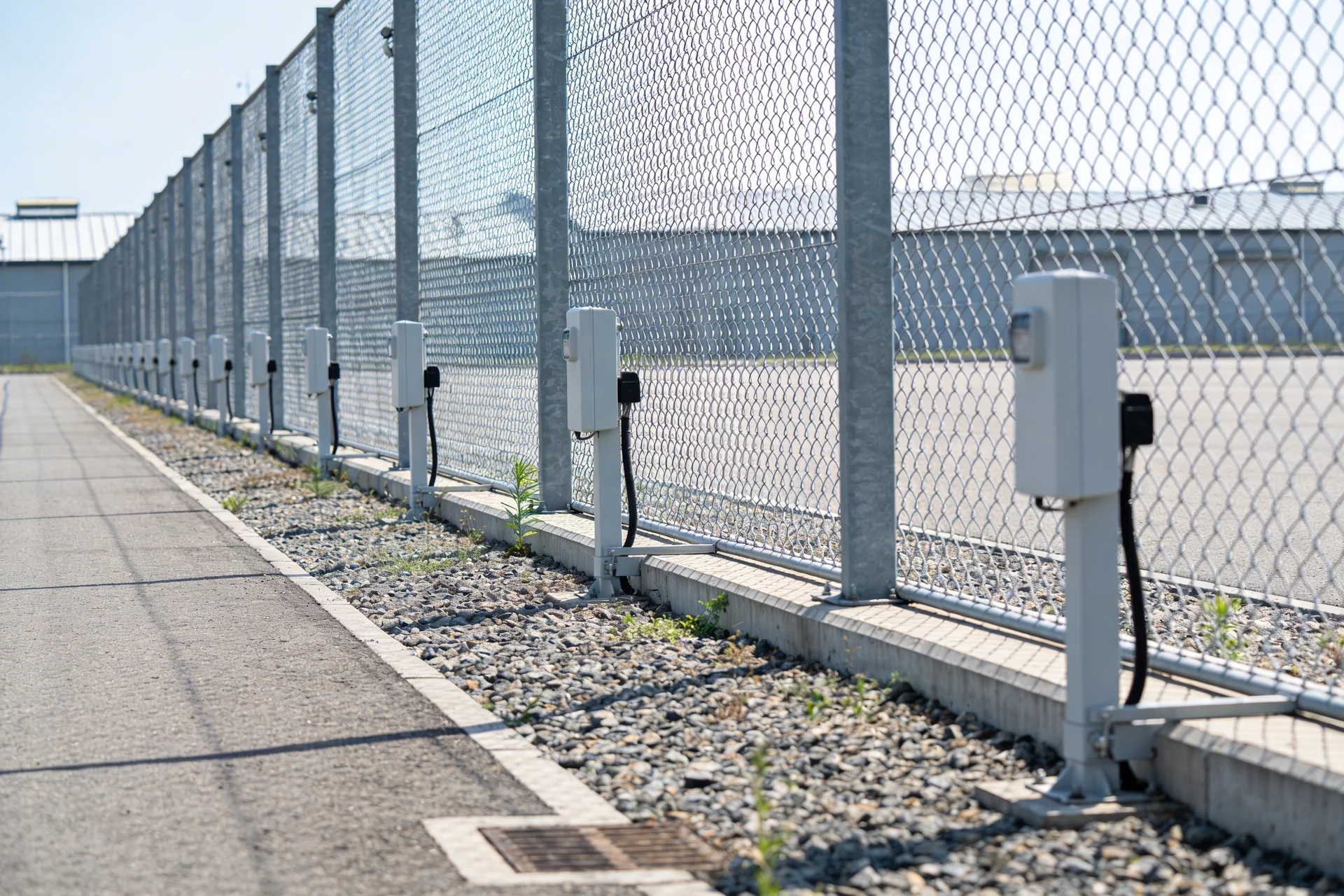
Perimeter security alarm (TSOP)


Working documentation: from 7 days
Price from 50000 roubles
We design perimeter security alarm systems that provide early detection of violations of territory boundaries and instant notification, increasing the security of facilities of any scale.
We design perimeter security alarm systems for industrial, commercial and residential facilities. The system includes motion sensors, infrared barriers, control points and centralized notification. A well-designed perimeter security alarm system ensures continuous border control, rapid response to threats and effective protection of the territory.
Perimeter security alarm systems (PSTN) - design of facility boundary protection with integration and monitoring
The production plant has a perimeter alarm, but it is constantly triggered by passing cars and the movement of birds. Security stops responding to real intrusion attempts because they get tired of false alarms. When expanding the territory of the plant, it turns out that the existing system does not scale and requires a complete replacement of the sensor perimeter. Or the alarm system is not integrated with video surveillance, and when the sensor is triggered, the guard does not see what happened on the perimeter.
This occurs during the superficial design of perimeter signaling. We design the PSTN so that the system reliably detects real threats, does not generate false alarms, and integrates with other security systems.
What is a perimeter security alarm system and why is it needed?
A perimeter security alarm system is a complex of detection sensors (infrared barriers, ultrasonic sensors, fiber-optic cable detectors) installed along the perimeter of the protected area, and processing and warning systems for border violations. TSOP integrates with video surveillance, access control system and security alarm within the perimeter.
For industrial enterprises, warehouses, logistics centers, critical infrastructure and public-sector facilities, PSTN is a critical element of the security complex, often a mandatory requirement of the insurer and regulatory authorities.
Why doesn't a perimeter alarm protect without professional design?
Professional PSTN design is critical to actual system performance. A superficial approach gives rise to characteristic problems:
- Blind spots on the perimeter - incorrect placement of sensors leaves areas through which undetected penetration is possible; the error is detected only during a real incident
- Systematic false alarms - an unsuccessful choice of the type of sensors for the conditions of the facility leads to responses to vehicles, animals, wind and precipitation; security stops responding to alerts and misses real threats
- Lack of differentiation of threat levels - without analytics and filtering logic, the system does not distinguish between a warning signal and a critical intrusion; the operator does not know how serious the situation is
- Isolation from video surveillance and ACS - when the perimeter sensor is triggered, the operator does not see what is happening in this area; countermeasures are delayed, the evidence base is not formed
- Inability to scale - when expanding the territory, the system is not expanded without reworking the existing logic; replacement becomes the only option
Proper design eliminates all these problems before installation.
Our approach to designing perimeter security alarms
- We develop TSOP taking into account the terrain, fences and control zones - analyze the topography of the territory, determine critical penetration points, select types of sensors (infrared barriers for straight sections, ultrasonic for complex terrain, fiber optic for high sensitivity) taking into account climatic conditions and sources of environmental interference
- We integrate alarm systems with video surveillance and access control systems - when the perimeter sensor is triggered, the system automatically switches the video stream to operator monitors in the area of interest, starts video recording in maximum quality, sends an alarm to a mobile phone, and, if necessary, blocks entrances to the territory
- We provide reliable detection and minimize false positives - we set up sensor sensitivity thresholds and filtering logic taking into account the climatic characteristics of the object, design a multi-level alarm system (warning, danger, critical penetration), include in the documentation the requirements for testing the system under various weather conditions
What is included in the design documentation for a perimeter security alarm system?
Design documentation stage - design documentation for expert review in accordance with Government Decree of the Russian Federation No. 87 dated 16.02.2008 No. 87 (as amended on 21.10.2025) “On the Composition of Design Documentation Sections and Requirements for Their Content”:
- Explanatory note describing the concept of perimeter protection, a list of threats and selected detection methods
- Plan of the protected area with sensor lines, critical points and control zones
- Description of the types of sensors used (infrared, ultrasonic, fiber optic) and their technical characteristics
- Architecture of the data transmission and warning system when the sensor is triggered
- Description of integration with video surveillance and access control system
- Calculation of an uninterruptible power supply for all sensors and devices
- Equipment specification: types of sensors, control panels, warning devices
Working Documentation Stage (WD) - working documentation for the installation organization:
- Installation drawings with exact installation coordinates for each sensor
- Schemes for laying power cables and signal lines around the perimeter
- Cable log with calculation of wire length for each section
- Drawings for mounting sensors on various types of surfaces (pillars, walls, fence mesh)
- Electrical connection diagrams and power consumption calculations
What standards are used to design perimeter security alarms?
The design of TSOP is regulated by regulatory documents in the field of perimeter security systems, integrated security and protection of critical infrastructure facilities. AYU-Project carries out design strictly according to the current editions of the following documents:
- GOST R 54830-2011 “Perimeter security systems. Classification. General technical requirements. Test Methods" is the main standard for perimeter security systems, establishing classification based on the detection principle, requirements for the probability of detecting an intruder, noise immunity, resistance to climatic influences and test methods in real conditions
- WD 78.145-93 Ministry of Internal Affairs of Russia “Systems and complexes of security, fire and security-fire alarm systems. Rules for the production and acceptance of work” - a regulatory framework for the design, installation and acceptance of perimeter security systems; regulates the composition of technical documentation and the procedure for putting the system into operation
- WD 78.36.003-2002 Ministry of Internal Affairs Russia “Engineering and technical strength. Technical means of security. Requirements and design standards for protecting objects from criminal attacks" - requirements for the selection of types of perimeter detectors, their placement around the perimeter and zoning depending on the security category of the object
- GOST R 53704-2009 “Security systems are comprehensive and integrated. General technical requirements" - the regulatory basis for the design of TSOP as a component of an integrated security system together with ACS, video surveillance and security alarms inside the perimeter
- GOST R 56602-2015 “Low-current systems. Security systems and access control systems. Application Guide" - requirements for the design of perimeter security systems in terms of cable routes, selection of cables and active equipment
- Government Decree of the Russian Federation No. 272 dated 25.03.2015 “On approval of requirements for anti-terrorism security of places where people are in large numbers” - establishes mandatory requirements for equipping objects with large numbers of people with perimeter detection and warning systems
- Federal Law No. 256-FZ from 21.07.2011 “On the safety of fuel and energy complex facilities” - for fuel and energy complex facilities, it determines mandatory requirements for equipping the perimeters of security alarm systems, video surveillance and access control, depending on the hazard category of the facility
- Government Decree of the Russian Federation No. 87 dated 16.02.2008 No. 87 (as amended on 21.10.2025) “On the composition of sections of project documentation and requirements for their content” - regarding the structure and content of the section of perimeter security alarm systems as part of the project documentation of the facility
For critical information infrastructure facilities and government institutions, the design of TSOP additionally takes into account the requirements FSB of Russia and other authorized bodies for the technical equipment of the perimeters of objects of national importance.
For which facilities is a perimeter security alarm system designed?
We develop perimeter security alarm systems for facilities of various purposes:
- industrial enterprises and production complexes with a large protected area
- warehouse complexes and logistics centers with a high concentration of material assets
- banking institutions and financial organizations subject to Bank of Russia requirements for perimeter protection
- government facilities and authorities with increased security requirements
- fuel and energy complex facilities: power plants, substations, oil terminals
- airports, port facilities and transport infrastructure facilities
- critical infrastructure facilities: water intake points, data processing centers, communication centers
- residential complexes and cottage villages with controlled entrances and perimeter
Why does the construction business trust AYU-Project to design perimeter security alarms?
Perimeter security alarm is the most vulnerable security system to design errors. The installed perimeter cannot be checked in normal mode - real blind spots, incorrectly configured response thresholds and lack of integration with video surveillance are detected only when a real penetration is attempted. AYU-Project eliminates these situations at the design stage:
- Calculation of coverage areas taking into account terrain and climate - for each section of the perimeter, the type of sensor is selected and the detection zone is calculated taking into account the relief, vegetation, precipitation and sources of thermal interference; blind spots are eliminated analytically before installation
- Logic for filtering false positives - sensitivity thresholds and filtering algorithms are included in the project, taking into account the real conditions of the object: transport load, animals, climatic features of the region
- Cross-system integration - TSOP is designed in a single logic with ACS, CCTV and a security alarm system inside the perimeter; joint response scenarios are agreed upon between systems before documentation is released
- Compliance with regulatory framework and requirements - documentation is generated in accordance with GOST R 54830-2011, WD 78.145-93, WD 78.36.003-2002 and RF PP No. 87; for fuel and energy facilities - taking into account Federal Law No. 256-FZ; Expert comments are eliminated free of charge as part of the contract
- 8+ years of experience and proven qualifications - membership in SRO, specialists in the NOPRIZ register, implemented objects across Russia: from industrial enterprises and fuel and energy complex facilities to logistics complexes and government institutions
How to order a project TSOP: stages of work
-
Submit an enquiry - the consultation is free
Form on the website or phone: +7 (383) 375-73-77 / +7 (923) 743-73-77. Indicate the type of object, area of territory and tasks of perimeter security. -
Receive a Commercial Proposal Within 1 Business Day
CP with the scope of work, price and deadlines. When ordering TSOP together with other systems, there is a discount. -
Approve the ToR and sign the contract
Documentation stage, requirements of supervisory authorities and insurer, battery life UPS and alarm levels. -
Topographic analysis of the territory and identification of vulnerabilities
Terrain, type of fencing, adjacent roads, sources of interference. Critical penetration points and risk areas for false alarms. If necessary, a specialist visit. -
Selection of sensor types for each perimeter section
IK barriers for straight sections, ultrasonic for complex terrain, fiber optic for maximum sensitivity, microwave for long distances. -
Designing Filtration, Alarm Levels and UPS
Logic for filtering false positives (double triggering, time windows). 3 alarm level: warning, danger, critical penetration. Calculation of UPS for 24 hours of battery life. -
Development of DD/WD and transfer to the customer
Territory plan with sensor lines, integration diagrams, installation drawings with exact coordinates and mounting options, cable logs, specifications. PDF and DWG. Expert comments are free.
Our Advantages


How We Work
Projects
Frequently Asked Questions
Key standards include RD 78.145-93 for intrusion alarm systems, RD 78.36.002-99 for technical security equipment and GOST R 56602-2015 for low-current systems, together with FSB requirements for nationally important facilities and insurer requirements for high-value property. The documentation complies with Russian Government Resolution No. 87, as amended on 21.10.2025.
SOS protects the interior of the building (sensors on doors, windows, in rooms). The TSOP protects the outer perimeter of the territory - site boundaries, fences, approaches to buildings. Together they form a two-level protection system: the intruder is detected on the perimeter, before attempting to enter the building.
The cost depends on the area of the protected area, types of sensors, terrain and level of integration with other systems. We will prepare a commercial proposal after receiving the territory plan and technical specifications.
When the main power is turned off, the system switches to the UPS. For perimeter systems, we calculate the UPS capacity for a minimum of 24 hours of autonomous operation in detection and alert mode - longer than for most other security systems.
Yes, if the system is designed with a reserve number of zones. When adding sensors to an extended perimeter, they are connected to the existing system. If the supply is exhausted, the instrumentation equipment will need to be replaced - this is much cheaper than replacing all the sensors on the perimeter.
Highly recommended. When the perimeter sensor is triggered, the system automatically converts the video recording to maximum quality in the area of interest and sends the video clip to the operator. This allows you to assess the reality of the threat in seconds, rather than having to go check the perimeter.
False alarms are minimized by the correct selection of sensor types, fine-tuning sensitivity thresholds, installing logical filters (for example, the sensor should fire twice with an interval of less than 3 seconds), as well as training analytics algorithms using examples of false alarms of a specific facility.
Main types: infrared barriers (for straight sections), ultrasonic sensors (for complex terrain with obstacles), fiber-optic sensors (maximum sensitivity and resistance to interference), microwave sensors (long distances). When designing, we select the optimal combination for a specific facility and climatic conditions.
Licences and Certificates


