
Automatic fire-extinguishing systems (gas, powder, aerosol, etc.)


Working documentation: from 28 days
Price from 50000 roubles
We design automatic fire suppression systems that provide effective local or zonal fire control, reduce damage risk and protect people, property and critical equipment.
AYU-Project designs automatic fire suppression systems for industrial, commercial and residential facilities. The scope includes system-type selection, equipment selection, pipeline routing, zone calculations and integration with fire alarm and fire-protection automation. A well-designed suppression system enables fast response, limits damage and protects life safety.
Why can the wrong fire suppression type be discovered only during a fire?
When activated, a gas installation installed in a leaky server room will not reach the calculated concentration of the fire extinguishing agent - the fire will continue to spread. A standard sprinkler over server racks, costing tens of millions of rubles, will flood the equipment without causing less damage than the fire itself. A powder module without a standardized start-up delay in a room with personnel is a direct threat to life. All these scenarios have one thing in common: the type of fire extinguishing installation and its parameters were determined not at the design stage, but according to the supplier’s catalog or “like a neighboring facility.”
Selecting the type of automatic fire suppression system is an engineering decision that must be justified in design documentation by analysis of fire load, room category, operating mode, building features and the requirements of the protected assets. AYU-Project performs this analysis as the first design step and records it in the design documentation - with calculations, regulatory justification and a complete interaction matrix of AFS with FAS and FPSA. Projects are developed according to the current regulatory framework: SP 485.1311500.2020 with Amendment No. 1 effective from 01.01.2026, SP 486.1311500.2020, SP 484.1311500.2020 (Change No. 1 from 01.09.2025) and Federal Law No. 123-FZ.
Automatic fire suppression design for construction projects: the result the client needs
What a construction company needs from an automatic fire suppression designer is not “compliance with standards” as such - it goes without saying. What is needed is: passing expert review from the first submission, the absence of conflicts with the HVAC, water supply and drainage, power supply and fire-protection automation sections, documentation according to which the installer works without constantly involving the chief project engineer, and the deadlines included in the construction calendar plan. This is exactly what AYU-Project records as obligations in the contract.
To achieve this result, we combine the development of AFS with related sections: ventilation and smoke ventilation - for correct zoning of valves and shutdown algorithms; FPSA - for a single control matrix; FAS - for coordinated fire confirmation algorithms. This reduces the number of iterations and eliminates interface issues between disciplines that would otherwise crop up during commissioning.
Types of automatic fire suppression systems designed by AYU-Project
Water sprinkler fire extinguishing - basic type of protection for public, commercial, office and warehouse buildings. A sprinkler with a thermal lock opens autonomously when the trigger temperature is reached, irrigating the area directly above the fire without activating the rest of the network. We design water-filled, air-filled and highly efficient ESFR systems for high-rise rack warehouses with loads based on storage groups.
Water deluge fire extinguishing - simultaneous zonal irrigation of the entire calculated area upon command from the control unit with a signal from FAS. Used in auditoriums, stage boxes, production lines with flammable liquids and conveyors. The deluge sprinkler is constantly open; The zone is fully activated when a fire is confirmed.
Water mist fire suppression - highly effective protection for volumes where a traditional sprinkler is unacceptable due to the risk of flooding. Droplet sizes up to 1 000 microns provide intensive cooling and steam inertization of the combustion zone at a water consumption 3-10 times less than that of a sprinkler. Scope of application: server rooms, data centre, transformer substations, museum collections, engine rooms. From 01.01.2026 Change No. 1 to SP 485.1311500.2020 introduced uniform requirements for the fire-test methodology for water mist systems, establishing the regulatory framework for the use of this type of installation.
Foam fire extinguishing - priority choice for the protection of petroleum products, flammable liquids and mixed fire loads of class B. We design installations with low, medium and high expansion foam depending on the characteristics of the substance being protected and the geometry of the protected volume.
Gas fire suppression - volumetric extinguishing without suppression-agent residue, without damage to equipment, with the possibility of immediate restoration of work after the fire is extinguished. Suitable for server rooms, data centre, electrical switchboards, archives and museum storage facilities. We design installations using refrigerants (HFC-227ea, FK-5-1-12, HFC-125), inert gases (IG-541, IG-55, IG-100, IG-01) and carbon dioxide (CO₂). The choice of fire extinguishing agent is justified by the standardized concentration, admissibility for people, the volume of the protected room and the temperature range.
Powder fire suppression - for industrial facilities, electrical installations, transport and rooms with flammable gases. We design modular installations (MPP) and centralized battery systems. A mandatory element of the FPSA algorithm is a delay of at least 30 s before discharge in rooms with constant occupancy.
Aerosol fire suppression - fire extinguishing aerosol generators (GOA) for cable tunnels, oil basements, electrical switchboards and closed technological volumes. Compactness and the absence of a pipeline network simplify installation in cramped conditions.
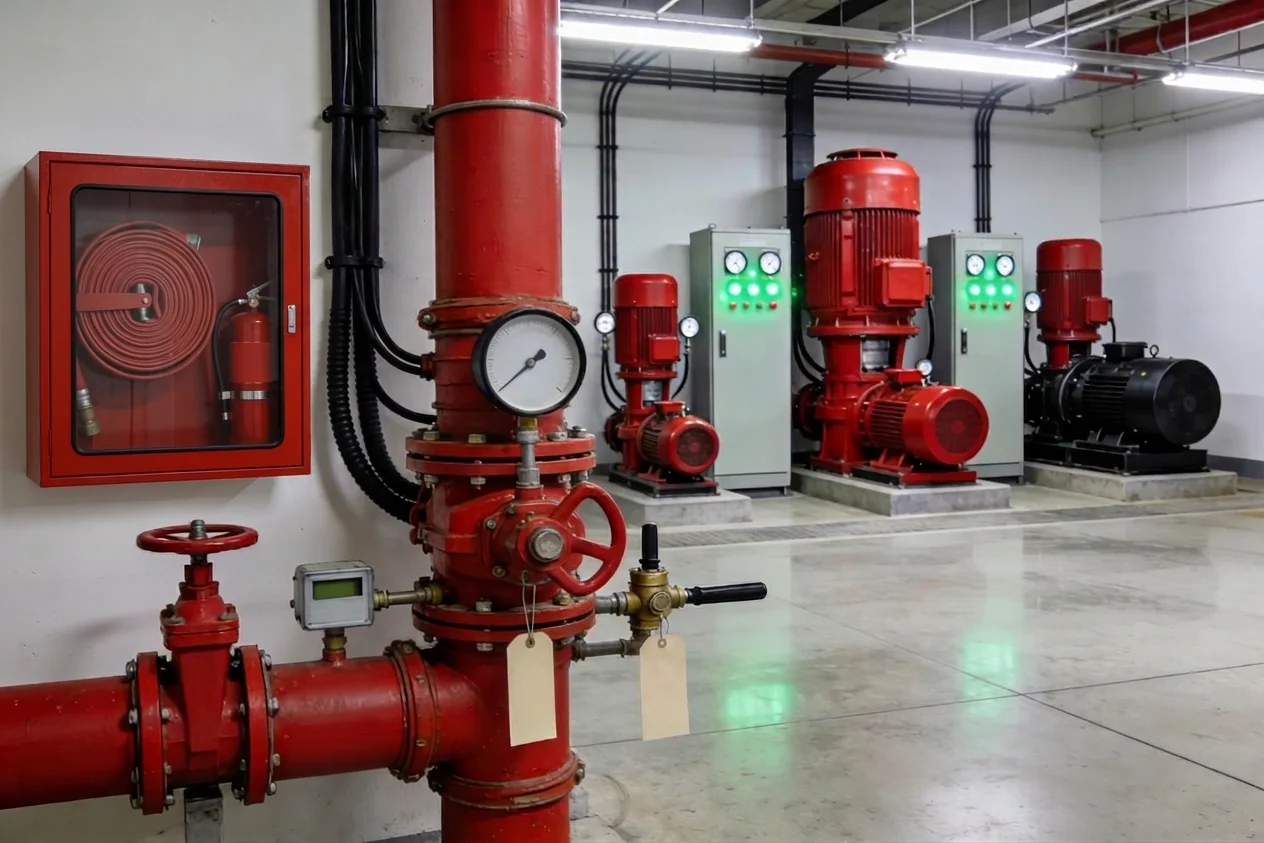
Internal fire water supply (IFWS) - we design systems with fire hydrants, pumping units (main, backup, jockey pump), water metering units and emergency water reserve tanks (NZV). IFWS is a mandatory system for SP 486.1311500.2020 for most public, industrial and warehouse buildings.
Why is a sprinkler system without hydraulic calculations only an illusion of protection?
Hydraulic calculation is the only tool that allows you to prove that at the most remote and highest point of the network, with the simultaneous operation of the estimated number of sprinklers, the normalized irrigation intensity will be ensured according to SP 485.1311500.2020. Without calculations, it is impossible to correctly determine the diameters of pipelines, the power of the pumping unit and the required water-supply volume.
The hydraulic calculations we perform at DD include:
- determination of the estimated irrigation area and the number of simultaneously operating sprinklers for groups of premises;
- calculation of water flow rate for each section;
- hydraulic calculation of the pipeline network from the dictating sprinkler to the control unit and pumping station;
- determination of required pressures and flow rates;
- selection of the type and power of the pumping unit;
- calculation of the emergency water reserve volume for the normal operating time of the installation.
Calculation of modules: what is calculated for gas, powder and aerosol
For gas installations, the calculation includes:
- standard extinguishing concentration of the suppression agent in the protected volume;
- adjustment for leakage through enclosing structures, taking into account the airtightness class of the room;
- standardized concentration retention time;
- depressurization condition.
If the room does not provide the required tightness class, gas extinguishing is physically ineffective - and we identify this before installation, and not after.
For powder and aerosol installations, the mass of the fire extinguishing agent is calculated based on the standard specific gravity according to certified fire tests, taking into account the configuration of the room and the presence of obstacles to the spread of aerosol or powder. The calculation results are included as a mandatory appendix to the design documentation.
How does AFS integrate with FAS and FPSA into a single algorithm?
For water sprinkler installations, automation is ensured by a thermal lock of the sprinkler, but control of pumps, transmission of an alarm signal to FAS and launch of FPSA require complete circuit design. For gas, powder, aerosol and deluge installations, the entire algorithm is built through FPSA: FAS confirms a fire in FAS control zone → FPSA maintains an evacuation delay → generates a start command → controls execution using feedback signals.
A critically important blocking algorithm: when starting a gas, powder or aerosol extinguishing system, the ASPP is obliged to turn off the anti-smoke ventilation in the protected room before supplying the fire extinguishing agent and keep it turned off for a regulated time - this is a direct requirement Federal Law No. 123-FZ. We work through all such blockages in the management matrix and consolidate them in the WD.
Fire suppression zoning and sectioning: how to optimize cost without loss of reliability?
Correct zoning of the sprinkler network into sections directly affects the cost: the number of control units, the volume NZV and the power of the pumping unit are determined by the number of sprinklers in the design section and the irrigation area. Too large a section - redundant pump and large tank; too small - an unreasonable number of control nodes.
For multifunctional facilities, we zone fire suppression systems taking into account fire compartments, functional classes of premises according to SP 486.1311500.2020 and planning pipeline routes. For industrial facilities with heterogeneous fire loads, we design combined solutions - for example, a water sprinkler in production areas and gas modules in technological compartments with electrical equipment - with a single control matrix within one DD.
Composition of design documentation and working documentation by AFS
Documentation is developed in accordance with Government Decree of the Russian Federation No. 87 dated 16.02.2008 No. 87 (as amended on 21.10.2025) “On the composition of sections of project documentation and requirements for their content”, SP 485.1311500.2020 (Change No. 1 from 01.01.2026), SP 486.1311500.2020, SP 484.1311500.2020 (Change No. 1 from 01.09.2025) and Federal Law No. 123-FZ.
Design documentation stage includes:
- an explanatory note justifying the fire suppression system type and the fire extinguishing agent;
- zoning of the facility with a list of protected premises and sections;
- hydraulic calculation (water and foam installations);
- calculation of quantity and mass OTV (gas, powder, aerosol installations);
- justification for the volume NZV;
- calculation of power supply redundancy;
- schematic diagram of the interaction AFS - FAS - FPSA.
Working Documentation Stage (WD) contains:
- structural diagram of the automatic fire control unit with equipment composition and sectioning;
- axonometric diagram of the pipeline network with pipeline diameters, location of sprinklers, control units and pumping equipment;
- plans for the placement of sprinklers, modules, control units and pumping stations with reference to the building axes;
- schematic electrical diagrams for controlling pumping units, control units and starting devices of modular units;
- control matrix AFS - FPSA with delays, interlocks and feedback signals;
- cable log and cable routing diagrams;
- power supply diagram with calculation battery bank for backup mode;
- equipment, piping and materials specifications;
- statement of quantities.
Regulatory design basis AFS
- SP 485.1311500.2020 with Change No. 1 (valid from 01.01.2026, order EMERCOM No. 1196 from 15.12.2025) - basic set of rules: requirements for installation parameters, pipelines, control units, pumping stations, fire test methods AFS TRV;
- SP 486.1311500.2020 - a list of objects subject to mandatory equipment AFS, indicating the required type;
- SP 484.1311500.2020 (Change No. 1 from 01.09.2025) - interaction of AFS with FAS and FPSA, fire confirmation and launch control algorithms;
- Federal Law No. 123-FZ “Technical regulations on fire safety requirements” - regarding the composition of fire protection systems and control algorithms AFS;
- SP 10.13130.2020 - internal fire water supply;
- GOST R 51052-2002 - water and foam fire extinguishing installations, control units;
- GOST R 53281-2009 - powder fire extinguishing modules;
- GOST R 53323-2009 - sprinklers;
- EAEU Technical Regulation 043/2017 - requirements for assessing the conformity of fire equipment;
- GOST R 21.1101-2020 - requirements for working documentation (WD) formatting;
- Government Decree of the Russian Federation No. 87 dated 16.02.2008 No. 87 (as amended on 21.10.2025) “On the composition of sections of project documentation and requirements for their content.”
How to order automatic fire suppression design from AYU-Project?
To receive a commercial proposal, it is enough to convey: the facility type and purpose, area and number of floors, the presence of premises with special requirements (server rooms, archives, production areas with flammable liquids, electrical installations), as well as preliminary requirements for the fire suppression system type - if they are formulated in ToR. If the choice of installation type has not yet been determined, we begin with a free consultation: we analyze the composition and category of premises, select the optimal type OTV and agree with the customer before the start of DD.
We work across Russia remotely. With the combined design of an automated control system with SPS, SOUE and ASPP within the framework of a single contract, there is a discount on the entire complex due to the combined development of related sections and unified management matrices.
How to order the design of AFS: stages of work
-
Submit an enquiry - the consultation is free
Form on the website or phone: +7 (383) 375-73-77 / +7 (923) 743-73-77. Indicate the type and purpose of the facility, area and number of floors, composition of premises with special requirements (server rooms, archives, production areas with flammable liquids). When ordering AFS with FAS, EVAC and FPSA together - a discount on the entire complex. -
Receive a Commercial Proposal Within 1 Business Day
CP with scope of work, cost and timing. The cost is determined by the type of automatic fire control system, the area and number of protected premises, the complexity of the pipeline network, the presence of a pumping station and the required firefighting water reserve. -
Initial-data analysis and selection of the fire suppression system type
Analysis of fire load, category of premises according to SP 486, design features of the building. For gas installations - assessment of the tightness of premises. Justification of the suppression system type and extinguishing agent. Coordination with the client before the start of design documentation. -
Signing the contract and zoning with calculations
Fixation of the composition, cost and terms in the contract. Zoning into sections taking into account fire compartments and functional classes of premises. Hydraulic calculation (water/foam) or calculation of modules (gas/powder/aerosol). Calculation of NZV and selection of a pumping unit. -
Design Documentation (DD) Development
Explanatory note with justification for the types AFS and OTV. Zoning with a list of sections. Hydraulic calculation or calculation of modules. Rationale NZV. Calculation of power supply redundancy. Schematic diagram of the interaction AFS - FAS - FPSA. Standards compliance review according to SP 485.1311500.2020 (Change No. 1) before transfer. -
Working Documentation (WD) Development
Block diagram of AFS with partitioning. Axonometric diagram of a pipeline network with diameters and sprinklers. Layout plans for sprinklers, modules, control units and pumping station. Control matrix AFS - FPSA with delays and interlocks (including interlock smoke ventilation for gas extinguishing). Cable magazine. Calculation battery bank. Specifications. Statement of work. -
Standards Compliance Review, Submission and Support during Expert Review
Standards compliance review according to SP 485.1311500.2020 (Amendment No. 1 of 01.01.2026), SP 486.1311500.2020 and Federal Law No. 123-FZ. Transfer to PDF and DWG. Support through expert review is provided at no additional charge until a positive opinion is issued.
Automatic Fire Suppression System Design Cost
| Scope of Work | Cost, rub. |
|---|---|
| Site inspection | Negotiable |
| Preparation of a commercial proposal (cost estimate) | Negotiable |
| Facility area, m2 | Cost, rub. |
|---|---|
| to 200 | 75 000 |
| 201 - 400 | 80 000 |
| 401 - 700 | 85 000 |
| 701 - 1000 | 92 000 |
| 1001 - 2000 | 110 000 |
| 2001 - 3000 | 190 000 |
| 3001 - 5000 | 230 000 |
| 5001 - 7000 | 260 000 |
| 7001 - 10000 | 310 000 |
| 10001 - 13000 | 325 000 |
| 13001 - 17000 | 335 000 |
| 17001 - 21000 | 350 000 |
| 21001 - 25000 | 360 000 |
Our Advantages


How We Work
Projects
Frequently Asked Questions
The combination of utility and fire-fighting water supply systems is permitted subject to the following conditions: the utility network must provide standardized pressure and flow for the AFS at the estimated hour of maximum water consumption, and the control units of the AFS must be equipped with check valves that prevent reverse contamination of drinking water. In practice, for medium and large facilities, it is technically and economically more feasible to have a separate fire-fighting water supply system with its own fire protection tank: it guarantees the availability of a regulated supply, regardless of the operating mode of the domestic water supply. The optimal solution is determined by hydraulic calculation at the DD stage.
Emergency water reserve (NZV) is the volume of water in a reservoir or storage tank that is reserved exclusively for firefighting needs and is not spent on household needs. The volume NZV is determined by calculation: the OTV flow rate for the automatic fire suppression calculation section (according to hydraulic calculation) is multiplied by the standardized operating time of the installation according to SP 485.1311500.2020. For sprinkler systems, the standardized time is, as a rule, 30-60 minutes, depending on the functional purpose of the building and group of premises. The NZV volume is added to the VPV flow rate, if present, and the result determines the power of the pumping unit.
For a medium complexity project (office building or retail facilities up to 10 000 m², water sprinkler system) - 3-4 weeks PD and 4-5 weeks RD. For facilities with gas or combined extinguishing, multi-section systems or non-standard design solutions - individually. With the combined development of automatic fire suppression with SPS, SOUE and ASPZ under a single contract, the time frame is reduced due to the parallel work of the team on related sections. All terms are fixed in the contract and are secured by the personal liability of GIP.
The fundamental difference lies in droplet size and water consumption. A standard sprinkler discharges 60-100 l/min when activated. A water-mist system achieves fire suppression with 3-10 times less water by producing finely dispersed droplets up to 1 000 µm in diameter, typically 100-400 µm. Their high specific surface area provides intensive cooling and steam inerting of the fire zone. For server rooms and museum collections, the resulting reduction in the total volume of water reaching equipment is critical to post-fire damage assessment. From 01.01.2026, Amendment No. 1 to SP 485.1311500.2020 introduced uniform fire-test requirements for automatic water-mist fire-suppression systems.
This is a direct prohibition of Federal Law No. 123-FZ, justified by the physics of the process: a gaseous fire extinguishing agent (GFA) is effective only when the standardized fire extinguishing concentration in the protected volume is achieved. Operating smoke-control ventilation removes the gaseous extinguishing agent from the room, and concentration is not achieved - extinguishing does not occur. The ASPP is obliged to block the maximum permissible concentration in the protected area until the GFFS is supplied and maintain the blocking throughout the entire regulated concentration retention time. This interlock is a mandatory element of the control matrix and is checked during acceptance tests.
Yes, but with fundamental differences from the standard solution. For warehouses with a height above 10 m, SP 485.1311500.2020 provides for the use of highly efficient ESFR (Early Suppression Fast Response) sprinklers with increased flow rates, or a combined system with above-rack and under-rack sprinklers. The required parameters (irrigation intensity, design area, OTV flow rate) are determined by storage groups from Appendix A to SP 485.1311500.2020 and confirmed by hydraulic calculations.
The list of facilities subject to mandatory equipment with automatic fire suppression is determined by SP 486.1311500.2020 according to the functional purpose of the building, its area, number of floors and fire hazard category. For properties not included in the mandatory list, automatic fire suppression may be provided voluntarily - to reduce the estimated fire risk, meet the requirements of insurers or the conditions of tenants. We determine whether automatic fire suppression is mandatory at a very early stage and incorporate this decision into the overall fire safety concept of the facility.
Gas extinguishing is a priority if the room is sufficiently tight (the tightness class allows you to maintain the calculated concentration of GFFS for at least the specified time) and the volume is compact. Key advantage: no waste residues, no equipment damage, immediate return to work. AFS TRV is the optimal choice for large protected volumes, restrictions on the storage of pressure cylinders, or when it is impossible to ensure the required tightness without expensive construction measures. The choice is justified in the DD based on the results of an analysis of the room: volume, tightness, value of equipment, requirements for the speed of restoration of functionality after extinguishing, presence of people in the room.
Licences and Certificates


