
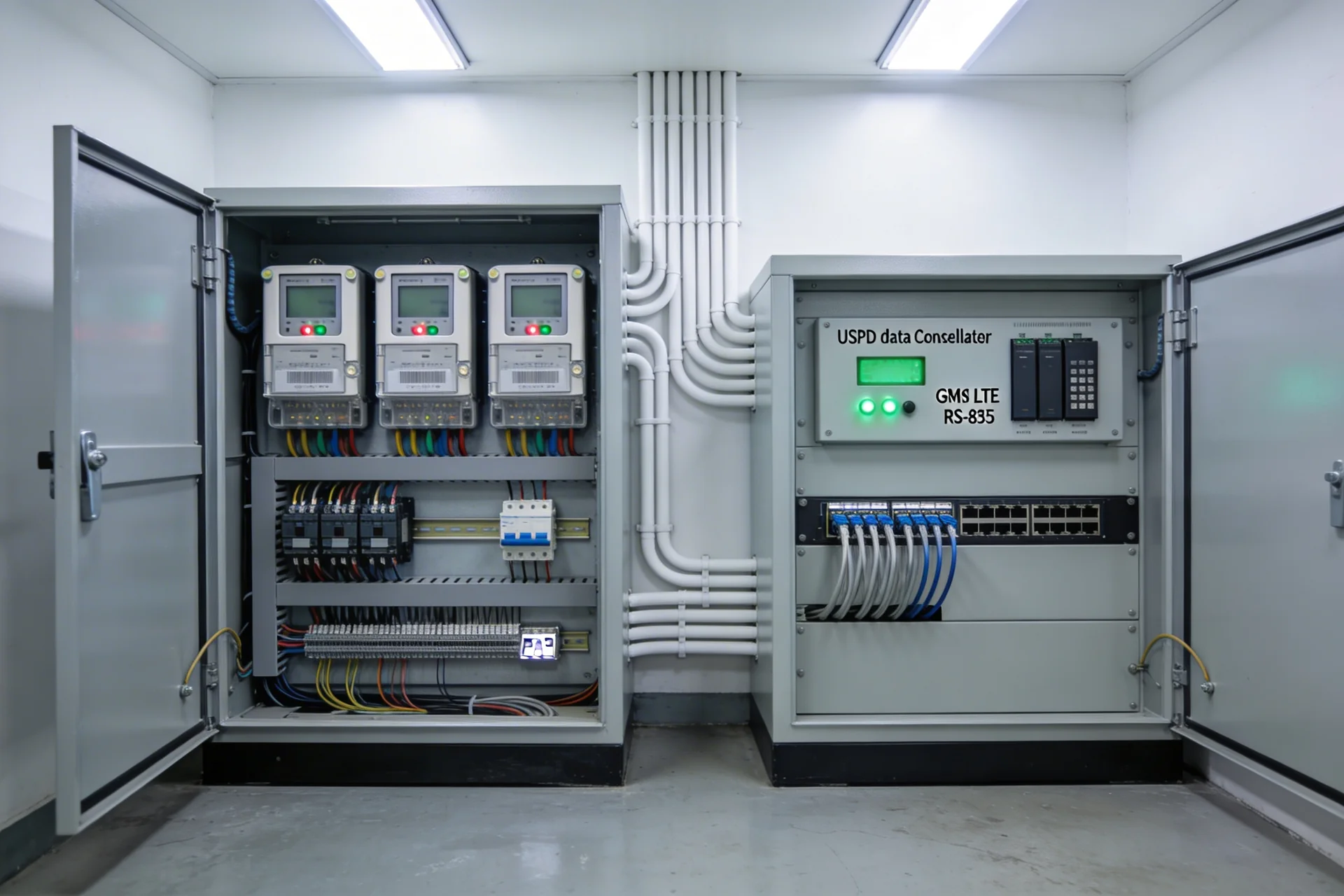
Electricity metering system


Working documentation: from 22 days
Price from 50000 roubles
We design automated electricity metering systems (AIIS electricity metering and AIIS TUE), providing accurate control of consumption, transparent commercial accounting and effective management of energy resources on site.
We design electricity metering systems, including automated systems for commercial electricity metering (AMR). We create solutions for collecting, monitoring and analyzing consumption data with the possibility of remote monitoring and reporting. A well-designed electricity control and metering system reduces losses, increases the transparency of calculations and increases the efficiency of energy consumption.
Why is inaccurate electricity metering not an error, but a financial loss for the facility?
An error in the electricity metering system costs the construction site real money: commercial losses when entering the wholesale market, discrepancies between consumed and paid energy in an apartment building, the inability to correctly distribute costs between tenants of a shopping center - all these are direct consequences of the absence or incorrectly designed automated metering system. And also - disputes with the network organization, refusals to accept the system for operation and sanctions for violating the requirements of the legislation on accounting.
AYU-Project carries out a full design cycle for the implementation of commercial and technical electricity metering: develops design documentation and working documentation on AIIS KUE and AIIS TUE for the wholesale market, as well as ASKUE for the retail market - with a guarantee of metrological compliance, full integration into the existing infrastructure of the facility and the readiness of documentation for examination.
What is the difference between AMR, AIIS electricity metering and AIIS TUE - and what does your facility need?
Behind the three abbreviations are systems that are fundamentally different in purpose, requirements and order of commissioning - and replacing one with another during design means moving towards a deliberately incorrect technical solution.
ASKUE (automated system for commercial electricity metering) is used by retail market participants - consumers and retail suppliers. The system automatically collects, stores and transmits consumption data for commercial settlements with an energy sales organization. For new facilities with connected power from 150 kW, its presence is mandatory in accordance with the requirements of network organizations.
AIIS KUE (automated information and measurement system for commercial electricity metering) is mandatory for subjects of the wholesale electricity and power market (wholesale electricity market): manufacturers, large consumer subjects wholesale electricity market, power grid companies. Unlike AMR, AIIS electricity metering is subject to registration in the Federal Register of Measuring Instruments and mandatory certification by a certification body that has the appropriate accreditation. Entering the wholesale market without a certified AIIS electricity metering is impossible in principle.
AIIS TUE (automated information and measurement system for technical metering of electricity) serves for detailed accounting of consumption within the facility for individual units, workshops, zones and consumer groups. It is not used for commercial settlements with energy sales, but is a key tool for energy management, identifying losses and increasing the energy efficiency class of a building.
Who legally needs AIIS electricity metering?
The presence of a certified AIIS KUE is a mandatory requirement for all subjects of the wholesale electricity and capacity market in the Russian Federation. These include generating companies, large consumers with sufficient capacity to enter the Wholesale Electric Power Market, as well as territorial grid organizations in terms of commercial payments for electricity transmission services.
An important nuance: some network organizations use the term “AIIS KUE” in their specifications for ASKUE for the retail market - which creates terminological confusion when creating design assignments. Our engineers analyze the specifications and type of market at the pre-project preparation stage and help to unambiguously determine the class and composition of the required system even before the development of the DD begins.
For which facilities is a technical electricity metering system relevant?
AIIS TUE is in demand where it is important to manage energy consumption from the inside, and not just balance with energy sales. Detailed consumption data by zones and consumer groups transforms the metering system from a formally necessary element into a real tool for reducing operating costs.
The most effective applications in construction B2B:
- Manufacturing plants - differentiation of consumption between workshops, production lines and household needs; identification of energy-intensive pieces of equipment; optimization of the load profile to reduce peak tariff payments;
- Shopping centers and multifunctional complexes - tenant-by-tenant sub-accounting, transparent payments without disputes; detailing of engineering systems - ventilation, air conditioning, elevators, lighting;
- Residential complexes - apartment-by-apartment and door-to-door metering, differentiation between communal and individual consumption, connection to platforms ZhKKh with personal accounts of residents and the ability to take readings remotely;
- Logistics complexes and data centers - load monitoring on an hourly basis, management of contractual power values, control of balances in power sections;
- Properties with multiple owners or tenants - automated commercial sub-accounting with reporting for each copyright holder.
What is included in design documentation and working documentation on AIIS electricity metering and AIIS TUE?
Project documentation for automated accounting systems is developed in accordance with Government Decree of the Russian Federation No. 87 dated 16.02.2008 No. 87 (as amended on 21.10.2025) “On the composition of sections of project documentation and requirements for their content”, requirements GOST R 8.596 and taking into account the technical conditions of the network organization on AMR. design documentation and working documentation include:
- Technical specifications for AIIS - agreed with the network organization; for AIIS electricity metering to wholesale electricity market - also with the certification body;
- System block diagram - AIIS levels, equipment composition, communication channels, integration interfaces with dispatch and billing systems;
- Functional diagram - logic for collecting, transmitting, storing and processing energy consumption data;
- Accounting equipment connection diagrams - types and accuracy classes of meters, connection diagrams for current transformers (CTs) and voltage transformers (VTs), diagrams of measuring circuits;
- Calculation of metrological characteristics - total error of the measuring channel taking into account the accuracy class of the meter, TT and TN;
- Equipment and cabling layout plans - installation locations of meters, data transmission systems, communication equipment, server part;
- cable magazine - power and information cables of metering systems, brand, cross-section, length;
- Equipment and Material Specifications - meters, DATD, communication cabinets, active network equipment;
- Explanatory note with justification for the adopted technical and metrological decisions.
How AIIS works from the inside: three-level architecture of the accounting system
The architecture of any automated information system - be it the ASKUE of an apartment building or the AIIS KUE of a substation of a wholesale market entity - is built on a single three-level principle.
Level 1 - measuring instruments. Electricity meters with a digital interface at each metering point. The accuracy class, type of transformers and connection circuit are determined based on load calculations and regulatory requirements: for the wholesale market - as a rule, class 0,2S; for retail - class 0,5S or 1,0.
Level 2 - data collection and transmission devices (DATD). Hubs that automatically poll meters via RS-485, PLC, GSM or Ethernet protocols form load profiles with a specified integration interval (usually 30 minutes) and provide data buffering in the event of a temporary loss of connection with the server.
Level 3 - data collection and processing server. A software package that receives data from DATD, generates consumption balances, generates accounting reports and provides data to users’ personal accounts, dispatch systems and - for wholesale market entities - to the data collection and processing center AIIS wholesale electricity market.
What regulatory requirements must the designed accounting system meet?
Electricity metering systems are designed in strict accordance with the regulatory framework, covering technical, metrological and information requirements. Key documents:
- GOST R 8.596-2002 - metrological support of measuring systems, AIMS classification and requirements for the error of the measuring channel;
- GOST R 52111-2003 - automated electrical energy metering systems in the retail market;
- GOST R 58940-2020 - intelligent electrical energy (power) metering systems;
- STO 70238424.17.220.20.004-2011 - requirements for organizing the operation of automated information systems;
- Decree of the Government of the Russian Federation No. 442 “On the functioning of retail electricity markets” - regarding the requirements for ASKUE and smart metering systems;
- Regulations of the wholesale electricity and capacity market (regulatory framework NP “Market Council”) - requirements for AIIS electricity metering entities wholesale electricity market;
- Government Decree of the Russian Federation No. 87 dated 16.02.2008 No. 87 (as amended on 21.10.2025) “On the composition of sections of project documentation and requirements for their content” - regarding the composition of DD.
For AIIS electricity metering on the wholesale market, we also prepare documentation for registering the system in the Federal Register of Measuring Instruments and support the certification procedure.
Why do developers and technical customers choose AYU-Project for accounting systems?
Metering systems are one of the most technically complex areas of design: they combine electrical engineering, metrology, telecommunications and software platforms. The error here is expressed in the refusal of the network organization to accept the system, commercial discrepancies in calculations, or the inability to certify AIIS to enter the wholesale market.
Experience at sites with stringent requirements. Implemented projects for Russian Railways, PJSC Rosseti Siberia, Federal Grid Company and NTEC - organizations for which the requirements for commercial accounting systems are traditionally higher than the market average. This experience is applied when working on any object.
Single point of responsibility. The metering system is designed in conjunction with all electrical sections - power supply circuit, transformer substations, power equipment. Not as a separate ToR for an IT contractor, but as an organic part of a single technical solution.
Ready for delivery. The documentation is generated with a focus on obtaining approvals from the network organization and accepting the system into operation without any comments on the composition and structure.
Fixed Schedule and Price enshrined in the contract without the right of unilateral revision.
Cost and procedure for ordering the design of AIIS KUE or ASKUE
The cost of development of design documentation and working documentation is determined individually: type of market (wholesale or retail), number of accounting points, need for certification of AIIS, presence or absence of DATD, requirements for integration with dispatch systems. Approximate calculation - through the online calculator on the website.
To receive an accurate commercial offer, leave a request: indicate the type and purpose of the facility, market category, estimated installed capacity and attach technical specifications to AMR, if they have already been received. Our engineer will contact you within one business day. We work across Russia remotely; initial consultation is free.
How to order the design of an electricity metering system: stages of work
- Submit an enquiry - the initial consultation is free
Form on the website or phone: +7 (383) 375-73-77 / +7 (923) 743-73-77. Type and purpose of the facility, market category (wholesale or retail), estimated installed capacity. Attach technical specifications to AMR if already received. - Receive a Commercial Proposal Within 1 Business Day
CP with a certain type of system (AMR, AIIS electricity metering or AIIS TUE), composition design documentation and working documentation, cost and timing. The price is fixed in the contract and is not revised. - Approve the ToR and sign the contract
We analyze technical specifications from the network organization, specify the type of market, the number of metering points, requirements for integration with dispatch systems and the need for certification of AIIS electricity metering. The contract fixes the scope of work, cost and timing. - Pre-project analysis: technical specifications, market type, system composition
We study technical specifications, a single-line power supply diagram, the act of delineating balance sheet ownership. We determine the accuracy class of meters, TT and TN, AIIS levels, data transfer protocols. For AIIS electricity metering wholesale electricity market - we analyze the requirements of the Wholesale Market Regulations. - Development of technical solutions and metrological calculations
Structural and functional diagrams of AIIS, diagrams for connecting meters with TT and TN, calculation of the total error of the measuring channel. Design of placement of DATD and communication equipment, cable magazine. - Preparation of DD and Expert Review Support
Set of DD according to Government Decree of the Russian Federation No. 87 dated 16.02.2008 No. 87 (as amended on 21.10.2025). Support of state or independent expert review, coordination with the network organization. Comments will be addressed within the agreed scope at no additional cost. - Release of WD and support of system acceptance into operation
Connection diagrams, equipment layout plans, cable log, specifications. We deliver in PDF and DWG formats. For AIIS electricity metering - support of certification and registration in the Federal Register of Measuring Instruments.
Our Advantages


How We Work
Projects
Frequently Asked Questions
DD (design documentation) is developed to pass expert review and obtain a construction permit: it contains technical solutions in a generalized form, structural and functional diagrams, metrological calculations. WD (working documentation) is developed for installation work and contains connection diagrams for metering equipment, equipment layout plans, cable logs and specifications - with accuracy sufficient for the direct execution of work. Most capital construction projects require both stages.
Main regulatory documents: GOST R 8.596-2002 - metrological support of measuring systems; GOST R 52111-2003 - automated commercial electricity metering system (ACEMS) in the retail market; GOST R 58940-2020 - intelligent accounting systems; Government Decree of the Russian Federation No. 442 - requirements for automated commercial electricity metering system (ACEMS); WECM Regulations (regulatory framework of the NP “Market Council”) - requirements for automated commercial electricity metering system (ACEMS); Russian Government Resolution No. 87 dated 16.02.2008 N 87 (ed. dated 21.10.2025) - composition of project documentation. For automated commercial electricity metering system (ACEMS) on the wholesale market, documentation is additionally prepared for registration in the Federal Register of Measuring Instruments.
You must contact your network organization to renew or obtain new TUs. The TU is generally valid for two years. We help prepare a set of documents for applying to a network organization and advise on the composition of the application.
Yes, we accept orders both for the comprehensive design of all electrical sections, and for the development of design documentation and detailed design documentation for the accounting system separately. In the second case, we will need a package of initial data: a single-line diagram of the facility’s power supply, an act of delimitation of balance sheet ownership and technical conditions for the automated commercial electricity metering system (ACEMS).
For capital construction projects that require state expert review, the accounting system section is included in the design documentation and undergoes examination as part of the overall package. The composition and content of the section are formed in accordance with the Russian Government Resolution No. 87 dated 16.02.2008 N 87 (ed. dated 21.10.2025) “On the composition of sections of project documentation and requirements for their content.”
Yes, this is part of our specialization. We develop a complete package of documentation for the automated commercial electricity metering system (ACEMS) of WECM facilities, including technical specifications, working documentation, program and test methods, and also support the procedure for certification and registration of the system in the Federal Register of Measuring Instruments.
Specifications for AMR must be requested before the development of the DD begins - they determine the accuracy class of the equipment, system levels, data transfer protocols and requirements for integration with the automated information system of the grid operator. If specifications have already been received, but their validity period has expired (usually 2), it is necessary to extend or obtain new ones before the start of design.
The main difference is the type of market and metrology requirements. ASKUE is used in the retail market and does not require state certification as a measuring instrument. AIIS KUE is intended for the wholesale market and is subject to registration in the Federal Register of Measuring Instruments and mandatory certification. The AIIS KUE requirements for equipment accuracy classes and documentation are much stricter.
Licences and Certificates


